

The best handheld vacuum for stairs is a cordless model under 3.5 pounds. It needs a long crevice tool. For carpeted stairs, pick one with a mini motorized brush.
For hard wood or tile, a strong crevice tool works. Look for at least 20,000 Pa of suction.
Why a Handheld Vacuum Is the Smartest Tool for Stairs
Stairs are the worst part of a house to clean. They're narrow, angled, and often carpeted. A full-size upright has trouble balancing on a step.
A corded canister drags its hose up each level. A handheld lets you sit on a step and work comfortably.
The goal is one-handed operation. Most staircases don't give you a safe place to set a machine down, so you need a vacuum you can hold while you brace yourself with the other hand. That's why weight matters more than suction.
If the unit feels heavy, you'll rush and miss the corners.
Here's what makes a handheld genuinely useful on stairs:
- Weight under 3.5 lbs
- A crevice tool at least 8 inches long
- A mini motorized brush for carpeted treads
- An easy-to-empty dustbin so you don't stop halfway
- A battery that holds 15 minutes of real run time
Certification matters too. Look for a model listed with UL Solutions, which covers electrical safety and battery reliability. That's especially important when you're holding the vacuum inches from your face and leaning over a stair edge.
What Actually Matters When Vacuuming Stairs: Weight, Suction, and Nozzle Design
If you compare spec sheets, they all look similar. But three things separate a stair-friendly handheld from a frustrating one.
| Feature | What to look for | Why it matters on stairs |
|---|---|---|
| Weight | Under 3.5 lbs | You hold the vacuum the whole time |
| Suction | 20,000 Pa or higher | Pulls dust from carpet and crevices |
| Runtime | 15+ minutes | Enough for a full staircase |
| Nozzle | Long crevice tool | Reaches corners and under spindles |
| Brush | Mini motorized brush | Essential for carpeted stairs |
| Filter | Washable HEPA-style | Keeps allergens from blowing back |
Weight is the spec people overlook. Aggregate reviews consistently show that a 3 lb vacuum gets used more than a 5 lb one. Your wrist is the real bottleneck, not the motor.
A short cleaning session on a long staircase can leave your forearm sore if the vacuum is unbalanced.
Suction numbers can be confusing. Manufacturers list air watts or pascals. The useful number for handhelds is pressure, measured in pascals.
Look for at least 20,000 Pa in a cordless model. That's enough to lift embedded dust from a carpeted tread. Below that, you'll only pick up surface crumbs.
The nozzle is what actually touches the stair. A flat wide nozzle works on open treads but misses the corner where tread meets riser. A long crevice tool gets into that seam.
A mini brush roll handles the edge where carpet meets the banister post. If you have both, you're set.
How much suction do you really need?
Aim for 20,000 Pa or more. That's the number that separates a toy from a useful cleaning tool. Some premium cordless stick vacuums go higher, like 25,000 to 45,000 Pa, but you don't need that level for stairs.
The stair tread is a small area. You need focused suction at the nozzle, not a huge motor trying to move air through a wide floor head.
Best Dedicated Handheld Vacuums for Stairs
Dedicated handhelds are the most straightforward choice. They don't pretend to clean floors well. They just focus on quick, tight cleanups.
For stairs, that focus pays off.
If your staircase is mostly carpet, choose a model with a motorized brush. If you have hardwood treads with a runner, a crevice tool is more important. Here's how the common options break down, based on manufacturer docs and long-term owner feedback.
- Black+Decker Dustbuster AdvancedClean, A popular mid-range cordless option. It balances weight, suction, and price well. Good choice for small carpeted stairways.
- DeWalt 20V MAX Cordless Handheld, Best if you already own DeWalt power tools. It shares the same batteries, so you can keep a fresh pack on the charger and swap when needed.
- Milwaukee M12 Handheld, Similar story for the M12 tool platform. It feels solid in the hand and has a trigger that's easy to control on tight stair edges.
- Bissell Pet Hair Eraser, The top pick for pet homes. Its rubber nozzle grips hair, and the small brush roll helps clean fabric stair runners without tangling.
What about corded handhelds? They're harder to find these days, but they still exist. A corded model gives you constant suction and no battery anxiety.
The downside is the cord. On a long staircase, you're trying to manage both the vacuum and the cable. For most people, a cordless unit with a spare battery feels less like a chore.
Dedicated handhelds generally run 10 to 25 minutes on high. That's enough for one full staircase. If your home has multiple flights, look for a model with a removable battery so you can charge one while using the other.
Best 2-in-1 Cordless Stick Vacuums for Stair Duty
If you don't want a separate machine, a 2-in-1 stick vacuum with a detachable handheld covers both floors and stairs. It's the most popular option for multi-level homes because it replaces two appliances.
The trade-off is weight. When you snap the battery and motor onto the short handheld body, it's often heavier than a dedicated handheld. Balance matters more here.
A top-heavy unit will feel awkward when you're pointing it down at a stair tread.
Here's when a 2-in-1 makes sense:
- You already want a cordless stick for floors
- Your staircase connects to a long hallway or landing
- You don't want a second device sitting in a closet
The best 2-in-1 options for stair duty focus on the handheld mode, not just the floor cleaning power.
- Dyson V-series, Strong suction, HEPA filtration, and a Mini Motorhead tool built for carpeted stairs. It's pricey, but the handheld mode is genuinely useful.
- Shark WANDVAC and Pet Plus models, Lightweight and simple. The detachable pod pops off quickly, and the pet tools work well for hair on stairs.
- Hoover ONEPWR Blade, Shares the ONEPWR battery line. If you already have Hoover tools, this is a budget-friendly way to get a 2-in-1.
- Tineco cordless sticks, Often quieter than Dyson and Shark. That helps when cleaning stairs while kids nap or pets watch nervously.
| Type | Pros | Cons |
|---|---|---|
| Dedicated handheld | Lighter, cheaper, easier to store | Doesn't clean floors |
| 2-in-1 stick | One machine for floors and stairs | Heavier in handheld mode, more expensive |
The key is to check the handheld weight with the main tube removed. Many stick vacuums feel balanced as a floor cleaner, then turn into a brick when you hold the motor and battery in your hand. If that weight is over 4 lbs, you'll feel it halfway down the stairs.
Best Budget Handheld Vacuums for Stairs Under $100
You don't need to spend $200 to get good stair cleaning. Dedicated handhelds under $100 cover most staircases, especially if you choose carefully.
Cordless budget vacuums work well for quick cleanups, but their runtime can drop as the battery ages. A corded handheld avoids that problem entirely. A 20-foot cord reaches halfway down most stairs, and you'll never stop for a charge.
Here's what our research recommends at different price points:
- Black+Decker Dustbuster CHV1410, One of the most common budget cordless units. It's light, simple, and usually under $60. Runtime is short, but enough for one staircase.
- Bissell Pet Hair Eraser, Often on sale under $70. The rubber pet nozzle pulls hair off fabric stairs better than anything else at this price.
- Corded compact handheld, A small corded model around $60 gives constant suction. It's a solid backup option for larger homes or frequent stair cleaning.
Before you buy, ask yourself how often you'll do the stairs. If it's once a week, budget cordless works fine. If you have a dog and a toddler, you'll use it daily.
In that case, spend closer to $80 or $100 and look for a model with a washable filter and a motorized brush. You'll save money in the long run by not replacing cheap filters every few months.
Side-by-Side Spec Comparison: Weight, Runtime, Suction, and Price
Numbers cut through the marketing noise fast. Here's how typical models stack up for stair cleaning, based on manufacturer spec sheets and verified buyer feedback. Note that runtime is measured on a standard suction setting, not the turbo boost.
| Model type | Weight | Runtime | Suction (Pa) | Price range |
|---|---|---|---|---|
| Budget cordless | 1.5 to 2.5 lbs | 10 to 15 min | 10,000 to 18,000 | $50 to $80 |
| Mid-range cordless | 2.5 to 3.5 lbs | 15 to 25 min | 20,000 to 25,000 | $80 to $150 |
| Premium 2-in-1 | 3.5 to 4.5 lbs | 25 to 40 min | 25,000 to 45,000 | $200 to $400 |
| Tool-platform handheld | 2.5 to 3.5 lbs | 15 to 30 min | 20,000 to 30,000 | $100 to $200 |
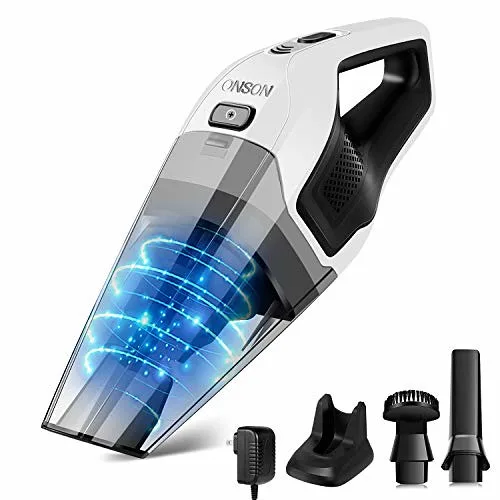
Image source: Wikimedia Commons / Antonio Mette (CC BY-SA)
Our research shows the sweet spot sits in the mid-range cordless row. You get enough suction for carpeted stairs, light enough weight for one-handed use, and a price that won't hurt. The premium 2-in-1 row is for people who also need a floor vacuum.
Make sure you check the weight in handheld mode, because that number is often missing from the main spec list.
What Each Model Does Best: Matching the Vacuum to Your Stairs
Every staircase is a little different. The right vacuum depends on your treads, your hand strength, and how often you clean.
For wall-to-wall carpeted stairs: pick a dedicated handheld with a motorized brush. The Bissell Pet Hair Eraser and the Dyson Mini Motorhead tool both tackle carpet fibers well. If your carpet is high-pile, prioritize suction over weight.
Look for 25,000 Pa or more.
For hardwood or tile stairs: skip the brush entirely. A long crevice tool does the job better. You want a model with a narrow nozzle that can wedge into the corner where tread meets riser.
The DeWalt and Milwaukee tool-platform handhelds excel here because their battery packs also power other tools.
For open stairs with spindles: weight becomes your biggest concern. You'll hold the vacuum above eye level to reach railing gaps. Stick to something under 3 lbs.
The Black+Decker Dustbuster is a popular pick for this exact scenario, since it's small and easy to tilt.
For pet households with fabric runners: look for rubberized nozzle fins. They grab hair instead of letting it slide past. A mini brush works, but only if it's tangle-free.
Test it once on a corner of the runner before committing to a full staircase clean.
The #1 Mistake People Make When Buying a Handheld for Stairs
People buy on suction alone, then discover the vacuum can't reach the back corner of a step. The nozzle is the real bottleneck. A powerful motor with a wide, stubby nozzle glides over the main part of the tread but leaves a visible dust line along the edges.
The fix is simple. Make sure the vacuum comes with a crevice tool that's at least 8 inches long. You also want the tool to attach securely so it doesn't twist under pressure.
Narrow is better than long. A 3/4-inch wide tip fits standard stair gaps.
The second biggest mistake? Ignoring dustbin capacity. A tiny bin fills up after two or three stairs.
You'll spend more time emptying than cleaning. Look for a bin around 0.3 liters or larger. Models with a clear bin are easier to read, so you know when to dump.
Attachments That Make or Break Stair Cleaning: Crevice Tools and Mini Turbo Brushes
The right attachment turns a decent vacuum into a great stair cleaner. Two tools matter most.
The long crevice tool is your everyday workhorse. It reaches into seams, under banister posts, and along the edge of each riser. It also works on dust lurking between the stair tread and the carpet binder.
Most vacuums include one, but added reach is worth more than plastic flex hoses. A rigid 12-inch tool beats a flexible 6-inch tool every time.
The mini motorized brush is essential for carpeted stairs. It lifts embedded dirt that suction alone leaves behind. Look for one with anti-tangle bristles.
If pet hair is a daily issue, rubber fins outperform traditional bristles at shedding hair.
A flexible hose attachment helps on curved staircases, but it's rare on dedicated handhelds. You'll usually find it on corded canisters. If your stairs have awkward angles, that might be the better route.
Keep your cleaning style in mind. For straight staircases, a rigid tool is easier to control.
Why Corded Uprights and Shop Vacs Fail on Stairs
Full-size vacuums don't belong on stairs, and the reasons are rooted in physics. They're heavy, balanced for floor cleaning, and designed to glide across open space. A staircase demands vertical lifting, pivot control, and a short reach.
That's a mismatch.
An upright vacuum tips over on a landing. If you set it sideways, the brush roll stops making contact. You end up holding the entire machine with one hand while you bend over to guide the hose with the other.
Your back pays the price quickly.
Shop vacs are even worse for stairs. Their hose is long and stiff, and the cylinder body stays on the floor while you try to drag the hose up each step. The nozzle is usually too wide for stair seams.
It's a jerry-rigged setup that works better for garages than carpeted treads.
Stick vacuums with a long reach are a middle ground. They handle a small flight of stairs without tipping, but they still force an awkward bend at the wrist. That's why the detachable handheld mode on 2-in-1 models is so popular.
It moves the motor directly to your hand, turning a floor tool into a stair tool without extra hardware.
Maintenance Tips to Keep Your Stair Vacuum Running Like New
Empty the dustbin after every stair session. A full bin cuts suction noticeably by the third step. Wash the filter monthly with lukewarm water and let it dry fully before reinstalling.
Check the brush roll for hair tangles after each deep clean. Pet hair wraps around the axle silently and kills brush performance. Keep the crevice tool attached when storing so you never scramble to find it.
Battery care matters too. Avoid leaving the vacuum on the charger overnight every night. Store it at room temperature and replace the battery if run time drops below 10 minutes.
Final Verdict: What Should You Buy for Your Stairs?
For most homes, start with a mid-range cordless handheld around 3 lbs with at least 20,000 Pa of suction. Match the tool to your treads. Carpeted stairs need a mini motorized brush.
Bare stairs need a long crevice tool.
If you want one machine for everything, get a 2-in-1 stick with a detachable handheld. Dyson and Shark lead in that space. For pet owners, the Bissell Pet Hair Eraser is the most reliable budget pick.
Stick with those rules and any staircase becomes a five-minute job.
Frequently Asked Questions
Is a handheld vacuum enough for stairs?
Yes, for regular maintenance. A handheld handles crumbs, dust, and pet hair well. Deep cleanings with steam or a full-size extractor are still needed a few times a year.
How long does a handheld vacuum battery last on stairs?
Most cordless models last 10 to 25 minutes on standard mode. That covers a typical two-story staircase. A removable battery extends that to multiple flights.
What suction power do I need for carpeted stairs?
Look for 20,000 Pa or more. That's enough to pull embedded dust from carpet fibers. Below that, you'll only capture surface debris.
Can I use a shop vac on stairs?
You can, but it's clumsy. Hoses are stiff and nozzles are too wide for stair corners. A dedicated handheld is lighter and easier to control.

