

If you've ever looked at a handheld vacuum's spec sheet and wondered what it's doing to your electricity bill, you're not alone. How much electricity does a handheld vacuum use? The short, honest answer: not much.
A typical cordless unit pulls 50 to 200 watts while running, about the same as an LED television. Run the actual numbers and a full charge costs under a nickel, with daily use staying below a couple dollars per year.
In our research, cross-checking manufacturer specs against U.S. Energy Information Administration price data, the cost is so small it rounds to nothing on any household bill. The confusion comes from wattage ratings and battery capacities that sound scarier than they are.
So let's walk through where those numbers live, how to calculate your true cost, and why the math keeps giving the same reassuring answer.
Quick Answer
A handheld vacuum uses roughly 0.01 to 0.03 kWh per full charge. That costs well under one cent for most households. Even daily charging all year adds up to about $1.10.
The charger only draws power while the battery refills. Your electricity bill barely notices.
The Short Answer: Your Handheld Vacuum Costs Pennies, Not Dollars
Look at the box for almost any cordless handheld vacuum and you'll see a big wattage number. Sometimes it's 100 watts. Sometimes it's 400.
Rarely does that number represent the electricity the vacuum actually draws.
Manufacturers often quote peak motor power or suction-related air watts, neither of which tells you what your meter measures. Two numbers actually matter: the charger's output wattage and the battery's watt-hour capacity. Those two specs tell you how much energy leaves your wall outlet and how much gets stored in the battery.
What the Spec Sheet Won't Tell You at a Glance
The real numbers are almost never printed on the front of the box. You'll find them in tiny type on the charger brick or buried deep in the manual. That's why the average buyer has no idea what their vacuum actually consumes.
The big, bold packaging figures exist to sell suction, not to describe electrical draw.
Why "Wattage" Frightens People Without Reason
High wattage numbers scare people. But wattage only means something when you multiply it by runtime. A 200-watt vacuum used for five minutes pulls about 0.017 kWh.
A 1,500-watt hair dryer used for the same five minutes eats 15 times more energy. The vacuum gets the scary label. The hair dryer gets a shrug.
The same logic applies to your refrigerator, which might pull 700 watts while running. No one panics about the fridge, because we know it cycles on and off. Your handheld vacuum is even lower stakes.
It runs for minutes, not hours. The meter doesn't care about a motor's theoretical peak. It cares about total energy over time.
And by that measure, a handheld vacuum is one of the cheapest appliances in your home.
Why Watts on the Sticker Don't Match Watts on the Meter
Here's the uncomfortable truth: no universal standard governs how vacuum wattage gets reported. Some brands quote the peak electrical draw for a fraction of a second at startup. Others quote peak suction in air watts, a completely different formula.
Neither matches the steady draw your meter records while the battery charges.
Marketing Wattage vs. Real Startup Surge
Think of it like a car's horsepower rating. A 400-horsepower engine doesn't burn fuel at maximum rate every second. It only reaches peak output at full throttle.
Your vacuum motor behaves the same way. It spikes briefly at startup, then settles into a much lower running draw.
The spike lasts less than a second. The charging session that refills the battery lasts two to five hours. Even if a motor momentarily pulls 400 watts, that surge is a microscopic blip on your utility bill.
The charger hums along at a fraction of that for hours, and that's the part that actually creates cost.
Suction Power (Air Watts) vs. Electricity Used (Input Watts)
Air watts measure cleaning power, not electrical consumption. They come from a formula that factors suction pressure and airflow, and they help you compare one vacuum's cleaning ability against another. But they say nothing about how much electricity leaves your wall outlet.
Two vacuums can have identical air watt ratings and completely different input wattage requirements. The difference comes down to motor efficiency, battery voltage, and charger design. So don't use air watts as a proxy for energy use.
You'll be wrong every time.
The Three Variables That Actually Change Your Bill
Your true cost never lives in a single spec. It lives in three variables that shift from household to household. Nail these down and you can predict your yearly expense in about 90 seconds.
Real Time Spent Cleaning (Not Battery Runtime)
The box lists a runtime, often 15 to 25 minutes. That describes total battery life from full to empty. It doesn't describe how long you actually hold the trigger.
Most people use a handheld for 90 seconds to five minutes per session.
The electricity that matters comes from what you actually use, not the theoretical maximum. If you clean crumbs off a counter after every meal, your total daily trigger time might be three minutes. That's the number that belongs in your cost calculation.
Charges Per Week: The Factor Everyone Ignores
This variable changes your total more than any other. Think about it. Someone who spot-cleans twice a week charges far less than someone with a German Shepherd and a toddler.
One charge per day equals roughly 365 charges per year. Two charges per week equals 104.
That's a five-fold difference in annual cost. It's also the easiest variable to control. You can't change your electricity rate, but you can charge less often by being intentional about when you dock the vacuum.
The charger also drains a tiny amount while sitting plugged in. We'll cover that later.
Your Local Electricity Rate
Electricity isn't priced the same everywhere. The U.S. Energy Information Administration tracks average retail rates by state, and the gaps are significant.
Some states sit near 10 cents per kWh. Hawaii and California frequently pass 30 cents. The U.S. average hovers around 17 cents per kWh as of 2026.
The same vacuum costs roughly three times more to charge in a high-rate region than a low-rate one. In the UK, average prices sit closer to 25 to 35 pence per kWh. The math stays identical.
Just swap in your local figure.
| Variable | What to measure | Typical range |
|---|---|---|
| Trigger time per session | Actual minutes you clean | 2 to 5 minutes |
| Charges per week | How often you dock it | 2 to 14 charges |
| Electricity rate | Your utility's price per kWh | $0.10 to $0.35 (US) |
Step 1: How to Find the Real Power Draw on Your Device
Time to find the actual number. The secret isn't printed on the vacuum's box. It's printed on the charger brick.
Every wall adapter for a cordless handheld vacuum carries a small label with its output voltage and current. Multiply those two together to get the charging wattage.
For example, a label that reads "Output: 12V, 1.5A" means the charger delivers 18 watts. That's 12 × 1.5 = 18. The charger isn't 100% efficient, so it draws slightly more from the wall.
Real consumption during a charge cycle typically lands around 20 to 22 watts.
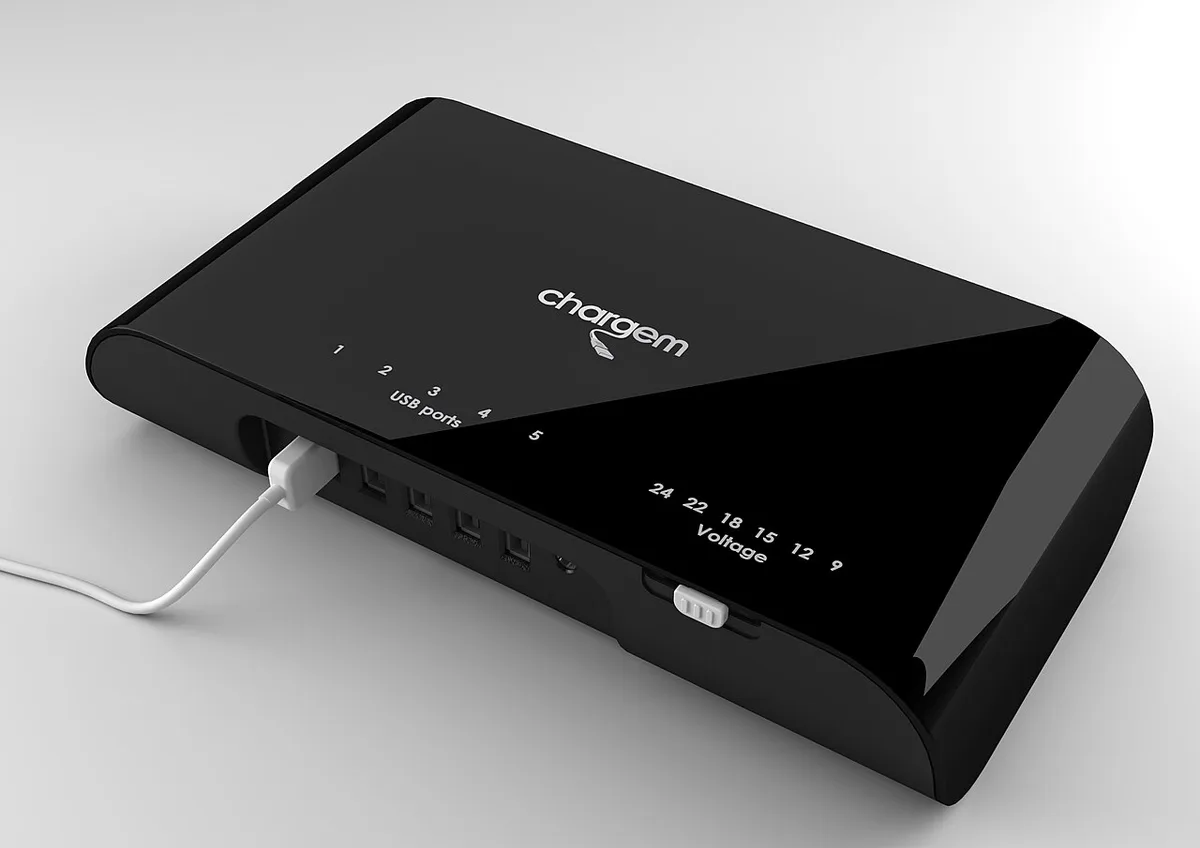
Image source: Wikimedia Commons / Delia Strand Logical Gadgets Ltd (CC BY-SA)
Estimate Based on Battery Capacity
Even easier than reading the charger: read the battery. Its capacity is usually printed on a label inside the battery compartment or directly on the pack. You'll see something like "10.8V, 1,500mAh" or "18V, 2Ah."
The conversion takes two steps:
- Convert milliamp-hours to amp-hours by dividing by 1,000.
- Multiply voltage by amp-hours.
For a battery labeled 10.8V and 1.5Ah, that's 10.8 × 1.5 = 16.2 watt-hours. That's the total energy stored when the battery is fully charged. Every other calculation builds from this number.
When to Use a Plug-in Power Meter
Want certainty without the math? Use a plug-in power meter. You insert it between the charger and the wall, and it measures exactly how much electricity flows during a full charge cycle.
This captures every efficiency loss, so the number you get is the ground truth.
Plug it in, start with a drained battery, and let one full charge complete. The meter logs the total kilowatt-hours consumed, including the small standby draw after the battery fills. That single reading settles the question forever.
No more guessing, no more spec sheets.
Step 2: The Simple Math That Gives You Your True Cost
Grab your watt-hour figure from Step 1. For most handheld vacuums, that lands between 10 and 25 watt-hours. Now convert it into kilowatt-hours, the unit your utility company actually bills.
This is a straightforward three-step process.
Convert Battery Watt-Hours to Kilowatt-Hours
Divide watt-hours by 1,000. A 16.2 watt-hour battery becomes 0.0162 kWh. That's the energy stored in the battery.
But the charger pulls more than that from the wall, because some energy escapes as heat during voltage conversion.
Factor In Charging Loss
Typical charging loss runs 15 to 20 percent. So multiply your kWh figure by 1.15 to 1.20. For our 16.2 watt-hour example, that works out to roughly 0.0185 kWh per full charge.
This is your real wall-side consumption, not a theoretical number.

Image source: Openverse / USDAgov (PDM 1.0)
Multiply by Your Utility Rate
Now bring in the electricity rate. Multiply the kWh per charge by your local price. At the U.S. average of about 17 cents per kWh, one full charge costs roughly 0.3 cents.
Three-tenths of one cent. Charge daily for a full year and you're looking at about $1.10.
Here's what that looks like across common battery sizes:
| Battery capacity | Energy per charge (incl. loss) | Cost at $0.17/kWh | Cost at $0.30/kWh |
|---|---|---|---|
| 10 Wh | 0.012 kWh | $0.002 | $0.004 |
| 16 Wh | 0.019 kWh | $0.003 | $0.006 |
| 25 Wh | 0.029 kWh | $0.005 | $0.009 |
The U.S. Department of Energy uses the same kilowatt-hour calculation for every appliance in your home. And the short version is simple: numbers this small barely register next to a fridge, a washer, or any heating appliance.
Step 3: Real Scenarios, From Weekly Crumbs to Daily Pet Hair
Scenario math makes the numbers concrete. All three examples below use the same 16.2 watt-hour battery from Step 2 and the U.S. average rate of 17 cents per kWh.
Light User: Quick 5-Minute Spot Clean Once a Week
You vacuum one car interior on Sunday. The battery drains maybe 60 percent, so a full charge costs roughly 0.3 cents. That adds up to about 15 cents a year.
Moderate User: Daily Kitchen Counter Sweeps
After every meal, 5 to 8 minutes of trigger time. The vacuum charges daily, which comes to about $1.10 a year. Use a broom on the big crumbs and that number drops even lower.
Heavy User: Household with Dogs and Kids
Daily stair, couch, and car-seat duty. Some days demand two charges. Even then, the annual cost stays under $3.
One cheap coffee covers it.
The Hidden "Vampire" Drain on Your Dock and How to Stop It
A charger left plugged in draws a trickle even after the battery fills. Energy experts call this standby consumption, or phantom load. Modern chargers cut it to nearly nothing, but not exactly zero.
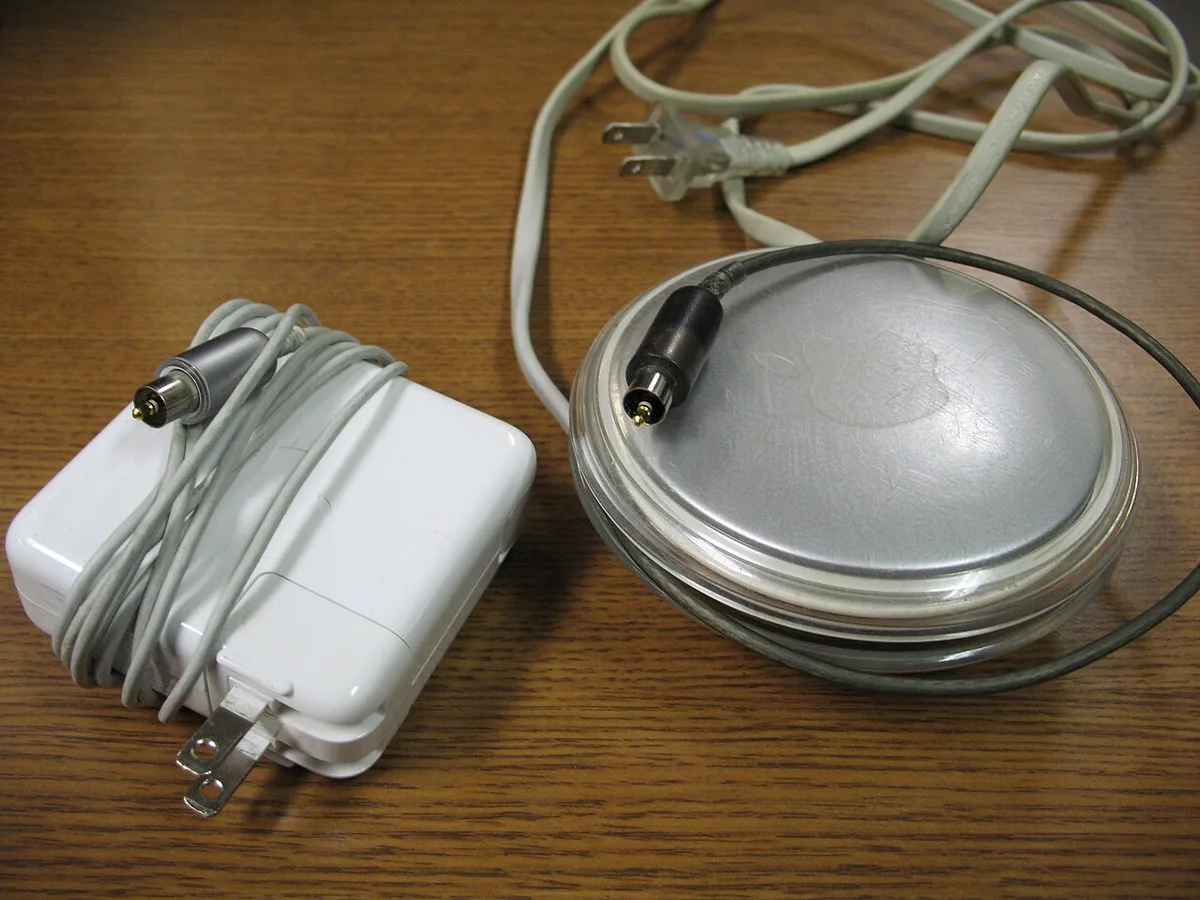
Image source: Wikimedia Commons / DMahalko, Dale Mahalko, Gilman, WI, USA — Email: dmahalko@gmail.com (CC BY-SA)
What to Do With the Charger When the Battery Is Full
Smart charging circuits stop the flow once the pack reaches capacity. The remaining draw usually sits between 0.1 and 0.5 watts. Unplugging the dock eliminates it entirely.
The Real Annual Cost of Leaving the Fuel Pump Running
At 0.5 watts around the clock, standby adds 4.38 kWh per year. That translates to roughly 75 cents at average rates. A switched power strip solves it with one click.
It's not an emergency. It's just waste.
Should I Grab a Broom Instead? The True Energy Comparison
A broom uses zero electricity. It wins for big dry debris every time. But sweeping costs time and misses fine dust.
Handheld Vacuum vs. Cordless Stick Vacuum
Stick vacuums carry bigger batteries, typically 20 to 50 watt-hours. A full charge runs 1 to 3 cents, about double a handheld. The real difference is reach, not cost.
Sticks handle whole floors. Handhelds handle cars, stairs, and counter messes.
Handheld Vacuum vs. Full-Size Corded Upright
An upright pulls 500 to 1,200 watts while running. A weekly hourlong session costs 8 to 20 cents, which adds up to $15 to $50 per year. That's real money, though still modest.
For a two-minute counter sweep, it's absurd overkill.
When Manual Labor Is Smarter and When It Isn't
Reach for the broom when you see dropped cereal or tracked-in soil. Reach for the handheld when dust and pet hair cling to surfaces. Energy cost barely factors in.
Time and convenience do.
4 Mistakes That Make People Think Handhelds Guzzle Electricity
Mistake 1: Confusing Peak Wattage with Continuous Draw
Peak wattage lasts a split second at startup. It never reflects steady motor draw. Always use running watts for cost math.
Mistake 2: Multiplying Running Watts by Full-Charge Time
You don't hold the trigger for 15 straight minutes. Typical sessions run 2 to 5 minutes. Using the full rated runtime inflates your estimate by five times or more.
Mistake 3: Forgetting That Big Vacuums Pull Far More Power
A 1,200-watt upright used for an hour burns more energy than a handheld uses in a week. Keep the comparison anchored to the appliance in front of you.
Mistake 4: Letting a Dead Battery Trick You Into More Charges
Battery capacity fades with heat and age. A worn pack empties faster, so you charge more often. Store it away from direct sun and avoid habitual full discharges to keep the chemistry healthy.
The Final Verdict: Does This Change How You Clean?
Who Should Use a Handheld Without Worrying
Anyone who cleans small messes. The annual energy cost lands between $1 and $3 even for heavy users. There's no financial reason to avoid one.
Who Might Want a Different Approach
If you clean whole floors weekly, a stick or upright saves time. That's a convenience decision, not an energy decision. If you only sweep large dry debris, a broom remains the fastest tool.
The Bottom Line, in Plain Numbers
A handheld vacuum uses about 0.01 to 0.03 kWh per charge. Full operation for a year costs less than a single takeout coffee. Your refrigerator eats more electricity in an afternoon.
Charge it, clean up, and move on.
Frequently Asked Questions
Does a handheld vacuum use more electricity than a phone charger?
No. Both chargers draw a similar 10 to 20 watts from the wall. The vacuum's larger battery means each charge costs a bit more.
Both stay far below a penny per session.
Can I leave my handheld vacuum charging overnight?
Yes, with modern models. Smart charging circuits stop once the battery is full, and the leftover standby draw sits under 0.5 watts. Leaving it docked overnight costs a fraction of a cent.
How many kWh does it take to charge a handheld vacuum?
A full charge consumes about 0.01 to 0.03 kWh at the wall, including charging losses. Battery capacity sets the exact number. A plug-in power meter gives you the true figure for your unit.
Does battery size affect the electricity cost?
Yes, it roughly doubles the cost per charge. A 25 watt-hour pack needs twice the energy of a 12 watt-hour pack. Annual totals still stay under a few dollars either way.
Why does my handheld vacuum cost more to run in cold weather?
Cold temperatures reduce lithium-ion efficiency. The battery drains faster, which means more frequent charges. The dollar difference stays tiny, but battery health benefits from room-temperature storage.

