

Corded vs cordless handheld vacuum: which is better? That question usually pops up when a full-size vacuum feels like overkill but you still want something that actually cleans. The honest answer is that neither type is universally better.
The right pick depends on your home, your car, and how often you plan to use it.
Manufacturer specifications and aggregate reviews show that corded handhelds keep a steady suction until you unplug, while cordless models offer real convenience with one catch: typical runtimes sit between 10 and 20 minutes per charge as of 2026. That trade-off drives most of the decision. Let's walk through it in plain terms.
Corded vs Cordless Handheld Vacuum: Which Is Better?
Why This Comparison Matters More Than You Think
Handheld vacuums are usually the second or third vacuum in a home. People buy them for cars, stairs, pet messes, and quick kitchen spills. They expect something small, grab-and-go, and genuinely useful.
That's where the corded versus cordless decision gets tricky.
A cordless handheld feels effortless. You pull it off the dock, use it for 30 seconds, and put it back. A corded model needs an outlet and a cord that has to be managed.
But that convenience comes at a cost. Cordless models run on batteries, and batteries fade, add cost, and eventually wear out.
Corded models, on the other hand, plug into the wall and keep sucking until you stop. They're often more powerful for the price too. The catch is the cord itself.
If you're cleaning a car in the driveway or a staircase far from an outlet, a corded unit can quickly become annoying.
This comparison matters because the wrong choice usually leads to a second purchase. Buy a cordless unit when you mostly clean small, quick messes, and you'll wonder why you didn't do it sooner. Buy a corded unit when you need sustained power, and the lack of a battery will feel freeing.
Quick Answer: The Short Verdict on Corded vs Cordless
If you need one tool that never dies mid-clean, buy corded. If you want grab-and-go convenience for quick pickups, buy cordless. Corded models win on price and sustained suction.
Cordless models win on freedom and portability. For most car, kitchen, and pet-hair jobs, a cordless handheld is the better everyday choice.
Corded Handheld Vacuums: The No-Nonsense Workhorse
Corded handheld vacuums plug into the wall with a power cord, usually 15 to 20 feet long. They're simple, sturdy, and easy to understand. They don't need charging, and they don't lose power as the job goes on.
Image source: Openverse / David Benware
What Corded Models Do Well
Corded handhelds are all about consistency. Since they draw electricity straight from the wall, suction stays at the same level until you unplug. That matters more than people think, especially if you're vacuuming upholstery or tight car corners that take a while.
They also tend to be cheaper. A corded handheld with strong suction can often be found in the $30 to $80 range, while a comparable cordless model usually starts higher. There's no battery to replace, and no worrying about running out of charge halfway through a chore.
For workshops and garages, corded models are a natural fit. You're usually near an outlet anyway, and sawdust cleanups don't follow a tidy schedule. Aggregate reviews report that corded handhelds rarely lose suction mid-task, which makes them dependable for longer cleaning sessions.
Where Corded Handhelds Fall Short
The cord is the whole problem. You have to drag it behind you, untangle it, and often chase it with an extension cord. A 15-foot cord sounds long until you're cleaning a minivan and the nearest outlet is in the house.
Corded handhelds also tend to be a bit heavier because the motor and power supply are built into the same body. They're not massive, but they don't feel as featherweight as cordless rivals. If you have limited grip strength or need to reach awkward spots, the extra weight and the cord can get old quickly.
Cordless Handheld Vacuums: The Ultimate Grab-and-Go Tool
Cordless handheld vacuums run on rechargeable batteries, usually 12V to 20V models. They're designed for speed and convenience. Grab them, use them for a few minutes, then drop them back on the charging dock.
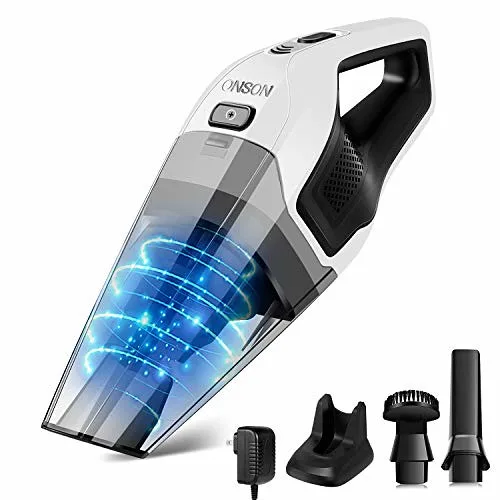
Image source: Openverse / shop8447
What Cordless Models Do Well
Cordless handhelds win on freedom. No cord, no outlet, no limits on where you can clean. You can vacuum your car in the driveway, do the stairs, or clean the couch without thinking about reach.
They're also lighter, with most models weighing 1.5 to 3.5 pounds. That makes them easier to hold above your head or use in one hand. For quick tasks like picking up cereal crumbs or pet hair, a cordless unit is usually the first thing you'll reach for.
Modern lithium-ion batteries have improved the segment. As of 2026, many mid-range cordless handhelds offer 15 to 20 minutes of useful runtime, which is enough for a full car detail if you work efficiently. The best part is that you can keep one charged and ready near the kitchen or garage.
Where Cordless Handhelds Fall Short
Runtime is the obvious limitation. A 20-minute run time sounds okay, but the motor is at full power only at the start. As the battery drains, suction fades noticeably.
If you're cleaning something heavy or deep, the last few minutes can feel weak.
Batteries also age. After a couple of years, lithium-ion cells hold less charge. Replacement batteries often cost $20 to $60, and some models make it hard to find replacements at all.
Charge times are another gripe, with many units needing 3 to 5 hours to top up.
Side-by-Side Comparison: Suction, Runtime, Weight, and Price
This table gives you the big-picture breakdown. It's based on typical specs across the current market, not one specific brand.
| Factor | Corded Handheld | Cordless Handheld |
|---|---|---|
| Suction | Stable until you unplug; generally stronger at the same price | Peak at full charge, then fades as battery drains |
| Runtime | Unlimited | 10 to 20 minutes typical, higher-end models a bit more |
| Weight | Usually 3 to 5 pounds | Usually 1.5 to 3.5 pounds |
| Price | $30 to $80 | $50 to $200 |
| Maintenance | Washable filter, occasional cord repair | Filter, plus battery replacement every 2 to 3 years |
| Best for | Workshops, garages, long tasks near an outlet | Cars, quick spills, pet hair, stairs, grab-and-go use |
Suction claims are often measured using standard testing methods. Organizations like ASTM develop performance tests for vacuum cleaners, and manufacturer specs usually reflect those guidelines. When you see a wattage number, remember that a cordless model's peak watts don't reflect what you get after 12 minutes of use.
Who Should Buy Corded And Who Should Go Cordless
Match the tool to your routine. If you clean in short bursts, cordless. If you clean in long, focused sessions, corded.
For car interiors, cordless wins because you move around the vehicle constantly. For garage work, corded wins because outlets are close and sawdust doesn't wait. Aggregate reviews show that most households are better served by cordless because quick cleanups are the main use.
For the Car
Cordless handhelds shine here. You can reach the backseat, trunk, and floor mats without dragging an extension cord. A 20V model with a crevice tool does a full interior detail in one charge, especially if you work fast.
For the Couch and Stairs
Pet hair and crumbs on upholstery are all about convenience. Cordless models with a motorized brush lift embedded fur quickly. Corded models work too, but the cord gets awkward on staircases.
For the Workbench
Sawdust and debris pile up fast. A corded handheld provides steady suction until the bin is full. The cord is a small inconvenience when outlets are nearby.
Common Mistakes Buyers Make
Don't buy on peak wattage alone. Cordless numbers drop as the battery drains. Check the filter too.
A clogged filter kills suction on any model, corded or cordless.
Also, don't use a dry vacuum on wet spills. That's a quick way to ruin a motor. And read the cord length before buying a corded model.
Fifteen feet may not reach your staircase or driveway.
Price comparison is another trap. A cheap cordless unit with low voltage often disappoints. Spending a bit more on a 20V model is usually worth the difference.
The Real Cost of Ownership
Batteries are the hidden expense. A replacement runs $20 to $60 every few years. Filters add $5 to $15 a few times a year.
Corded models skip the battery cost entirely.
Over five years, a cordless unit often costs more than its sticker price. A corded unit stays close to list price. Aggregate buyer feedback shows that many owners only realize this after the first battery dies.
Maintenance That Keeps A Handheld Vacuum Alive
Empty the bin after every heavy use. Wash the filter monthly and dry it fully. Check the cord on corded models for damage.
Store cordless units with a partial charge.
These steps take five minutes and keep the vacuum pulling like new. A clean filter makes the biggest difference in suction.
Expert Tips for Better Cleaning Results
Use the right attachment. Crevice tools reach vents and cracks. Upholstery brushes lift pet hair better than a bare nozzle.
Go slow on fabric to let suction pull out deep debris. Start top-down in a car. And for delicate surfaces, lower the suction or hold the nozzle slightly away.
Final Verdict: How to Choose Your Handheld Vacuum
Choose cordless if your cleaning happens in short bursts. Choose corded if you tackle longer jobs near an outlet. Most households will be happiest with a cordless 20V model for everyday messes and a corded unit for deep details.
If you already own a full-size vacuum, a handheld is a supplement, not a replacement. Cordless fills the gap for stairs, cars, and quick spills. Corded fills the gap for workshops and sustained cleanups.
Pick based on your most frequent chore, and you'll get years of use from either one.
Frequently Asked Questions
Are cordless handheld vacuums powerful enough?
Yes, for most everyday messes. They handle crumbs, dust, pet hair, and light car cleaning well. They're not built for deep carpet cleaning or heavy construction dust.
How long does a cordless handheld vacuum battery last?
Most last 10 to 20 minutes per charge as of 2026. Premium models reach the higher end of that range. Battery age and motor speed affect the actual runtime.
Can I use a corded handheld vacuum in my car?
You can, but it's awkward. You need a nearby outlet or a long extension cord. A cordless model is much more convenient for car detailing.
Do cordless handheld vacuums lose suction over time?
Yes. As the battery drains, the motor slows and suction drops. Over the years, total runtime also shrinks.
Regular filter cleaning helps, but battery aging is unavoidable.
Is a handheld vacuum worth it if I already own a full-size vacuum?
Yes, if you have the right expectations. It won't replace your main vacuum, but it will save you from dragging the big machine up the stairs or out to the car. It's a tool for quick jobs, and it does those very well.

