

Can handheld vacuums clean mattresses? Yes, but not all handheld vacuums are up to it. The models with a true HEPA filter and decent suction can handle loose dust, pet hair, and crumbs.
Weaker ones just push dirt around the surface. The real trick is knowing which type you have and what the job actually requires.
Our research and manufacturer specifications show that a handheld with a true HEPA filter can trap dust mite debris, which is roughly 10 to 20 microns across. As of 2026, that is still the standard for allergy-friendly cleaning. Once you understand what is actually living in your mattress, you will see where a handheld fits.
Let's start with the short answer.
Quick Answer: Yes, But It Depends
Can handheld vacuums clean mattresses? Yes, but the job depends on your vac. A HEPA-filtered handheld with strong suction removes surface dust, hair, and crumbs.
It cannot extract deep dirt or treat stains. Use it for routine maintenance, not a deep clean.
What “Clean” Actually Means for a Mattress
When we talk about a clean mattress, we mean two different things. Visible clean means no crumbs, hair, or dust on the surface. Allergen clean means removing the microscopic particles you can't see.
Most of us only notice the visible kind.
Over time, a mattress collects dead skin cells, dust mite feces, pet dander, and pollen. Dust mites are tiny creatures that feed on dead skin. Their droppings are a common allergy trigger.
According to the U.S. Environmental Protection Agency, indoor allergen control starts with regular cleaning of surfaces like bedding and mattresses.
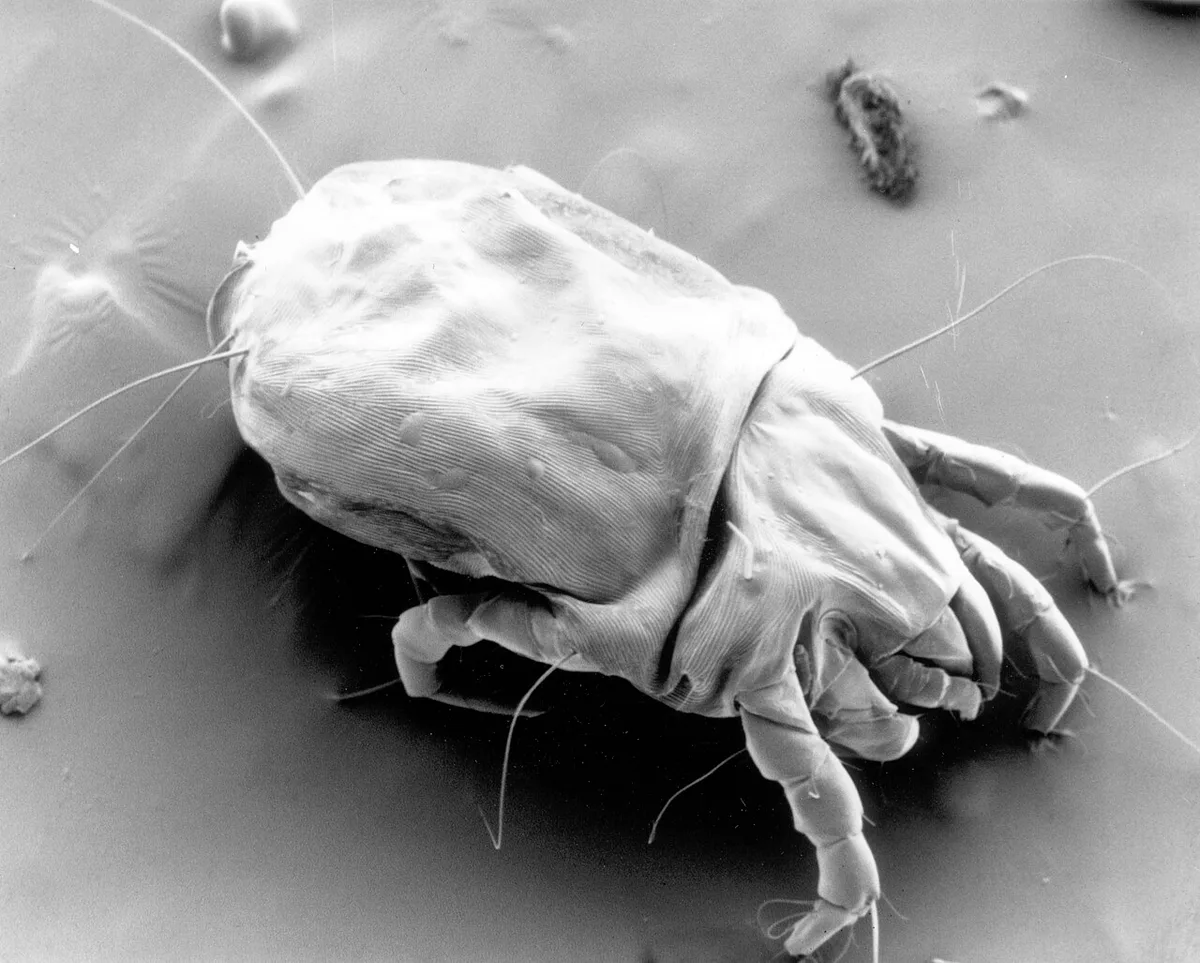
Image source: Wikimedia Commons / Matt Colloff, CSIRO (CC BY)
A HEPA filter captures 99.97% of particles at 0.3 microns. That is small enough to trap dust mite feces. A standard foam filter, by contrast, lets many of those particles pass straight through the exhaust.
That is why some vacuums just blow allergens back into the air.
Here is the part that surprises people. Vacuuming cannot kill dust mites or remove body oils that have soaked into the foam. It only removes what is loose on the surface.
For deep stains or sweat saturation, you need steam cleaning, an extractor, or a professional service.
The 4 Variables That Decide If Your Handheld Is Up to the Job
Your handheld will only do the job if four things work in your favor. Let's check them one by one.
Suction Power: The 60-Second Check
Suction power for handheld vacuums is measured in air watts. Most cordless handhelds fall somewhere between 15 and 60 air watts. You want at least 20 for mattress dusting.
Below that, the brush just moves dirt across the surface.
| Air watts | Realistic for a mattress |
|---|---|
| Under 15 | Loose hair and crumbs only |
| 15-30 | Surface dust, fine allergens |
| 30+ | Embedded dust, seams, tufts |
Manufacturer specifications can be optimistic, so treat air wattage as a starting point. If you already own a handheld, do a quick test. Run it over a bare mattress and see if the dust bin fills with fine powder.
That powder is dead skin and dust mite debris. If it stays on the mattress, your suction is not strong enough.
Filter Type: HEPA vs. Standard
To earn a HEPA label, a filter must capture 99.97% of particles at 0.3 microns. Dust mite feces are about 10 to 20 microns, so a true HEPA filter catches them easily.
A standard foam or pleated filter catches the bigger stuff but lets fine particles escape through the exhaust. You may not see it, but it is in the air. If you have allergies or asthma, skip any handheld without HEPA and a sealed exhaust.
The filter is only as good as the seals around it. A loose filter housing or a worn gasket lets unfiltered air leak past.
Attachments: Which Tools Matter
The right attachment changes everything. A wide upholstery brush covers large flat areas faster. A crevice tool reaches the seams, buttons, and tufts where dust hides.
A motorized brush roll helps with pet hair, but it can damage memory foam or latex.
If your handheld only has a narrow nozzle, it is still useful for edges but not for the full mattress top. If you have a motorized brush, keep it off soft foam. If you are cleaning a traditional innerspring, it is fine.
For most mattresses, a simple upholstery brush and a crevice tool are enough.
Battery Life: Runtime Math
Battery runtime matters more than you would think. A full mattress takes about 5 to 10 minutes to vacuum completely, plus another 5 if you flip it. Many cordless handhelds run 15 to 60 minutes per charge, so a lower-end one may die halfway through.
If your vac is underpowered and short-lived, you will rush. Rushing means less suction contact time, which means a worse job. A corded handheld solves the runtime problem entirely.
For cordless models, look for at least 20 minutes of usable runtime under load, not the test numbers on the box.
When a Handheld Vacuum Is the Right Tool
There are situations where a handheld vacuum is genuinely the best choice. Here is where it earns its keep.
- Weekly maintenance between sheet changes
- Spot-cleaning pet hair and dander
- Cleaning a guest bed right before visitors arrive
- Reaching an RV, boat, or dorm mattress
- Homes with stairs, where a full-size vacuum is a hassle
If you keep a mattress protector on the bed, a handheld vacuum once a week keeps everything fresh. Without a protector, vacuuming is still useful, but you will need a deeper cleaning more often. For allergy households, a HEPA handheld is a practical first line when you also wash bedding in hot water weekly.
That combination tackles the two biggest sources of allergens: dust mites and dander.
Signs Your Handheld Vacuum Isn't Cutting It
Your handheld might be failing the job without you knowing it. Look for these warning signs.
- Your allergies still flare up after vacuuming
- The dust bin fills fast, but the mattress still feels gritty
- You can smell dust in the exhaust flow
- The upholstery brush just slides over the surface with no resistance
- A beater bar leaves marks on memory foam
- You are only cleaning the center, skipping edges and seams
If more than two of those signs appear, your handheld is not the right tool for this task. Time to upgrade, add a mattress encasement, or book a professional cleaning. That is not a failure.
It just means the job needs different equipment.
How to Vacuum a Mattress the Right Way (Step by Step)
Here is the routine we recommend, based on manufacturer care guides and common best practices. It takes about 10 minutes.
- Strip all bedding and wash it in hot water, at least 130°F, to kill dust mites.
- Check the mattress care label. Some foam mattresses should not be flipped.
- Pick up any loose crumbs or objects by hand first.
- Attach the wide upholstery brush for the main surface.
- Vacuum in overlapping, slow passes across the entire mattress top.
- Switch to the crevice tool for seams, buttons, tufts, and edges.
- Flip the mattress if the label allows it, then repeat.
- Optional: sprinkle a light layer of baking soda, wait 30 minutes, then vacuum it off.
- Let the mattress air out for 15 to 30 minutes before remaking the bed.
- Empty and clean the handheld dust bin after every use.
Work slowly. The longer the vacuum stays on a spot, the more embedded dust it pulls out. A quick back-and-forth glide only catches the top layer.
What About Stains, Liquids, and Odors?
A handheld vacuum will not fix these. Vacuuming only picks up dry debris. Liquid spills, sweat stains, and odors have soaked into the layers below the surface.
For fresh spills, blot with a clean cloth first, then sprinkle baking soda to absorb moisture. Wait several hours and vacuum the residue. For set-in stains, use an upholstery cleaner or a enzyme-based cleaner made for mattresses.
Avoid soaking the mattress, since moisture can reach the core and cause mold.
Odors usually mean bacteria or sweat in the padding. Baking soda helps on the surface, but a deep clean or professional extraction is the real fix. If you are using a handheld for maintenance, it will not prevent this kind of buildup.
It just slows it down.
Common Mistakes That Waste Your Time
People make the same errors over and over. Here is what to avoid.
- Vacuuming a wet stain and pulling moisture into the motor
- Using a non-HEPA handheld and spreading allergens through the room
- Rushing the surface instead of making slow, overlapping passes
- Ignoring the sides and seams, where dust mites gather
- Using a motorized brush on memory foam or latex
- Forgetting to wash the bedding afterward, so fresh sheets pick up old dust
- Emptying the dust bin indoors, which can stir allergens back into the air
The biggest mistake is expecting a handheld to do a deep clean. It cannot. A handheld is a maintenance tool, not a replacement for professional cleaning.
Better Alternatives If Your Handheld Keeps Coming Up Short
If your handheld fails the test, you still have options. Here is how they compare.
| Option | Best for | Limits |
|---|---|---|
| Full-size upright vacuum | Deep daily cleaning of carpets and mattresses | Heavy to carry upstairs |
| Cordless stick vacuum with handheld mode | Quick floor plus mattress cleaning | Smaller dust bin, shorter runtime |
| Canister vacuum with upholstery tool | Strong suction without bag strain | Awkward hose setup |
| Upholstery extractor | Stain removal and wet cleaning | Expensive, bulky |
| Professional cleaning service | Deep allergens, whole mattress | Costs more, requires scheduling |
A full-size vacuum with a HEPA filter often outperforms any handheld. That is because it has stronger suction and a bigger brush head. If you own one, use the upholstery attachment before buying anything new.
The best tool is the one you already have with the right filter.
What Numbers to Look For When Buying a Handheld for Mattress Duty
If you decide to upgrade, shop by specs, not brand colors. Here are the numbers that matter.
- At least 30 air watts of suction
- True HEPA filter with a sealed exhaust system
- A crevice tool and a wide upholstery brush included
- At least 20 minutes of real runtime below full charge
- A washable filter to cut long-term costs
- A dust bin you can empty without touching the debris
Do not worry about boost modes or fancy cyclonic claims. A simple design with a sealed HEPA path will beat a complicated one that leaks air. Read the manual before buying to confirm the exhaust is sealed.
If the manual does not say HEPA, treat the filter as standard.
Frequently Asked Questions
Can I use a handheld vacuum on a memory foam mattress?
Yes, but use a low-suction setting if you have one. Skip the motorized brush roll entirely. A soft upholstery brush and a crevice tool are safer.
Memory foam is soft, so aggressive brushing can create permanent surface damage.
How often should I vacuum my mattress?
For allergy-prone households, vacuum the mattress every two weeks. For everyone else, once a month is enough. Vacuuming every time you change sheets is a good habit, since that is when the mattress is already exposed.
Does a HEPA handheld really help with dust mite allergies?
Yes, when it is truly HEPA and the exhaust is sealed. Dust mite feces are about 10 to 20 microns, well above the 0.3 micron cutoff. The bigger issue is consistency.
Vacuuming weekly and washing bedding in hot water works better than any single deep clean.
Can a handheld vacuum remove dead skin cells from a mattress?
It can remove loose dead skin cells from the surface. The ones embedded deep in the fibers need stronger suction or professional extraction. Think of a handheld as a surface sweeper, not a deep fiber cleaner.
Should I vacuum a mattress after using baking soda?
Yes. Baking soda helps absorb surface moisture and odors, but it leaves a chalky residue. Use a HEPA handheld to remove it fully.
Wait at least 30 minutes after sprinkling so the baking soda has time to work.
Final Decision Guide: Should You Keep Using Your Handheld?
Run through these questions and let the answers pick for you.
- Does your handheld have a true HEPA filter? Yes means keep going. No means you are probably blowing allergens back into the room.
- Does it have at least 20 minutes of runtime? Yes means you can finish the job. No means you will rush or skip half the mattress.
- Can you attach a crevice tool? Yes means you can clean seams and edges. No means you will only clean the flat area.
- Are you expecting it to remove stains? If yes, it will disappoint. Handhelds remove dry surface debris, not soaked-in moisture.
If you answered yes to the first three and no to the last one, your handheld vacuum is a solid tool for mattress maintenance. Use it weekly, keep the filter sealed, and wash your bedding in hot water. If you answered no to more than two questions, pair your handheld with a full-size vacuum or book a professional deep clean.
Either way, a handheld is a starting point, not the whole solution.

