

So, what horsepower should a shop vacuum have? The short answer is a lot less than the sticker on the box claims. Most residential shop vacuums are rated between 3 and 6.5 peak horsepower, but that number is mostly marketing.
The real specs to check are amperage, airflow (CFM), and water lift. As of 2026, most home shop vacuums run on a standard 120V, 15-amp household circuit. A 10-amp motor draws about 1,200 watts, which equals roughly 1.6 real electrical horsepower.
Let's break down why the "peak HP" label is so misleading and how to choose the right vacuum.
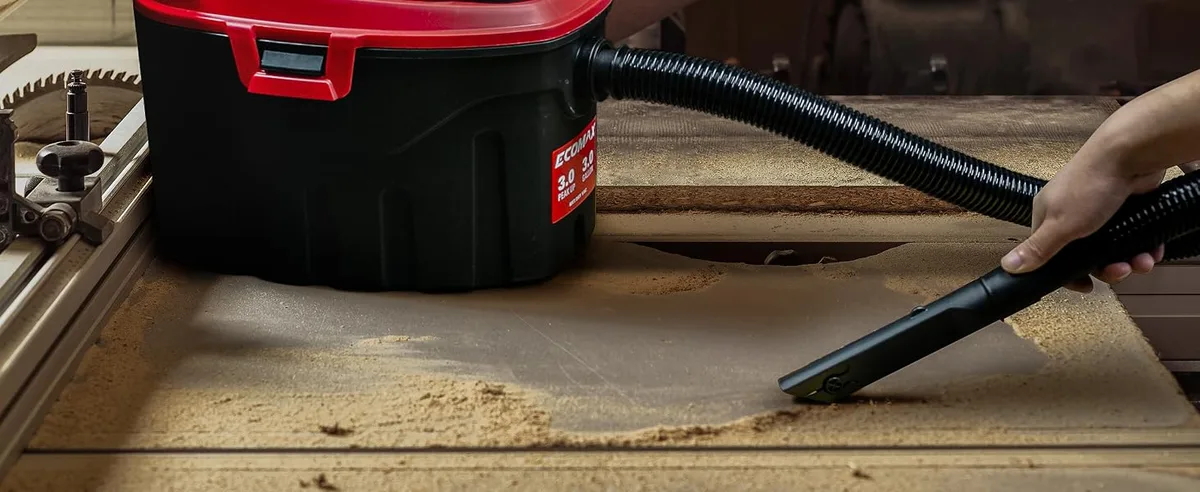
The Horsepower Myth: Why That "6.5 HP" Sticker on the Box Isn't What You Think
Shop vac boxes love showing huge horsepower numbers. That's because manufacturers use peak horsepower, a lab measurement taken with no hose attached, no filters, and no debris. It's the motor's maximum theoretical output for a split second during startup.
It isn't a usable number.
Real cleaning happens under load. The motor has to spin an impeller, pull air through a hose, and push against dirt and filter resistance. That's continuous power, and it's far lower than the peak number.
A typical 10-amp motor that claims "6.5 peak HP" actually delivers only about 1.5 continuous horsepower.
Here's the simplest proof that peak HP is unreliable: two vacuums with the same motor amperage can show completely different peak HP claims. One might say 4.5 HP, the other 6.5 HP. Same motor, different stickers.
So treat that number as a rough hint that the motor exists, not as a way to compare models.
What you should compare is amperage, airflow, and suction. We'll cover all three in detail.
Quick Answer: What Horsepower Do You Actually Need?
For typical garage, workshop, and DIY cleanup, you need a shop vacuum with 8 to 12 amps. That translates to roughly 1 to 1.75 continuous horsepower. Light duty jobs like car interiors and small spills need only 5 to 8 amps.
Heavy jobs like sawdust, drywall dust, and construction debris call for 10 to 12 amps.
Here's a quick formula: volts × amps = watts. Then watts ÷ 746 = horsepower. A 10-amp vacuum on a 120V outlet produces about 1.6 HP.
That's plenty for most home users.
| Task | Recommended Amps | Approx. Continuous HP | Typical CFM |
|---|---|---|---|
| Light dust, car cleaning | 5 | 0.8 | 50–70 |
| Sawdust, workshop debris | 8 | 1.3 | 70–100 |
| Construction, heavy debris | 10–12 | 1.6–2.0 | 100–150 |
| Wet spills, flooding | 10–12 | 1.6–2.0 | 80–120 |
The takeaway is simple. Don't shop by the horsepower sticker. Shop by amperage, CFM, and water lift.
How Shop Vacuum Horsepower Is Measured
There are three types of horsepower ratings you'll see on a shop vacuum.
- Peak horsepower, the inflated lab number from startup current with zero load.
- Running horsepower, the output during normal operation, still measured under ideal lab conditions.
- Electrical horsepower, derived from real power draw using volts × amps ÷ 746.
The only honest number is electrical horsepower, because it's based on measurable input. But even that doesn't tell you how much suction you'll feel at the hose. Motors lose energy to heat, friction, and impeller inefficiency.
Let's run the math for a typical 10-amp model:
- 120V × 10A = 1,200 watts.
- 1,200 ÷ 746 = 1.61 horsepower.
That's the power the motor consumes. Actual cleaning power is much lower, usually 5% to 10% of that, depending on hose size, filter condition, and tank design. So when a spec sheet says "rated horsepower," take it with a grain of salt.
Your best move is to ignore horsepower entirely and focus on CFM and water lift.
The Two Numbers That Matter More Than Horsepower
CFM and water lift predict real cleaning performance. Horsepower doesn't. Here's what each one means.
CFM (Cubic Feet per Minute)
CFM measures airflow volume. It's how many cubic feet of air move through the hose each minute. High CFM is great for picking up lightweight debris like sawdust, leaves, and plastic shavings.
It also helps cover open areas like garages quickly.
Most household shop vacs deliver 50 to 150 CFM. For context, a human blowing through a straw produces about 1 CFM. So 100 CFM is a serious gust.
Water Lift (Inches of Sealed Suction)
Water lift measures suction pressure. Specifically, it's how high the vacuum can pull water up a tube under sealed conditions. It's expressed in inches.
More water lift means the vacuum can grab heavier material, like wet carpet, stuck-on dirt, or dense drywall dust.
Good shop vacuums achieve 40 to 80 inches of water lift. Anything above 80 inches is usually a heavy-duty commercial unit.
Here's the trade-off. High CFM with low water lift is like a strong fan. It moves light stuff fast but struggles with dense debris.
High water lift with low CFM is like a thick straw. It grabs heavy material but covers ground slowly. A balanced vacuum has at least 80 CFM and 50 inches of water lift.
Hose diameter also plays a role. A 1.5-inch hose moves nearly double the air of a 1.25-inch hose. So between two models with identical CFM ratings, the wider hose will feel stronger.
Decision Guide: What Horsepower Should Your Shop Vacuum Have?
Use this simple step-by-step to match a vacuum to your real needs.
Step 1: Identify your heaviest cleanup task.
What's the worst thing you'll vacuum? Weekend sawdust? Renovation debris?
A flooded garage? That determines the power you need.
- Fine dust and drywall: want strong water lift.
- Large chips and shavings: want high CFM.
- Wet spills and flooding: want high water lift plus wet pickup capability.
Step 2: Check your garage or workshop circuit.
Most household outlets are on a 15-amp circuit. A 12-amp shop vac leaves only 3 amps for lights and tools on the same circuit. That works, but don't run a table saw at the same time.
If your workshop has a dedicated 20-amp circuit, you have more room for a bigger vacuum.
Step 3: Choose by amps, CFM, and water lift.
Here's the decision branch:
- Casual homeowner doing car cleaning, small spills, and light sawdust: 5 to 8 amps, at least 60 CFM, 40 inches of water lift.
- Weekend woodworker dealing with sawdust and shavings: 8 to 10 amps, at least 80 CFM, 50 inches of water lift.
- Contractor or pro handling construction debris and long hoses: 10 to 12 amps, 120 CFM or more, 60+ inches of water lift.
- Flooded basement or large wet spills: 10 to 12 amps, high water lift around 80 inches, and a filter rated for wet pickup.
If you're torn between two sizes, buy the larger one. An underpowered vacuum will frustrate you for years, and the price difference between an 8-amp and a 12-amp model is usually small.
Comparing Shop Vac Power Ratings: Real Specs, Side by Side
Let's look at what your money actually buys. We've pulled typical specs from common shop vac categories, based on manufacturer data and industry reporting. These aren't exact models, but they represent what you'll find on shelves.
| Vacuum Class | Peak HP Claim | True Amps | CFM | Water Lift | Best For |
|---|---|---|---|---|---|
| Compact / car vac | 2–3 HP | 4–6 | 40–60 | 30–40 in | Light dust, car interiors |
| Homeowner / small shop | 3–5 HP | 8 | 70–100 | 45–55 in | Sawdust, DIY, spills |
| Heavy-duty / contractor | 5–6.5 HP | 10–12 | 100–150 | 60–80 in | Construction, flooding |
Notice something? Peak HP claims don't track cleanly with amperage. A "6.5 peak HP" vacuum might still draw only 10 amps.
That's because peak HP is derived from inrush current, not steady operation.
What you're really paying for at $150 versus $300 is build quality, filter type, hose diameter, and extra features like a drain port or a blower function. The motor difference is smaller than the stickers suggest.
So when comparing two models, list their CFM, water lift, amp draw, and hose size. The one with better numbers in those columns is the better vacuum, regardless of HP.
Best Use Cases: Matching Motor Power to Your Real Jobs
Different jobs demand different power characteristics. Here's how to match them.
Sawdust and woodworking
Sawdust is light, so airflow matters more than suction. Look for at least 80 CFM and a wide hose. A 1.5-inch hose helps prevent clogging with wood chips.
If you connect the vacuum to a power tool, check that it has a tool-trigger outlet or a remote start feature.
Car detailing
Car cleaning needs moderate suction with the right nozzle. You don't want to suck up coins, screws, or seat cushions. A 5 to 8 amp vacuum with a few small attachments works well.
Water lift around 40 inches is enough for upholstery and floor mats.
Wet spills and flooded basements
This is where water lift matters most. Look for at least 60 inches of sealed suction. Make sure the filter is rated for wet pickup, and always use a GFCI outlet.
That's the same kind of electrical protection you'd want for any wet-area equipment.
Construction cleanup
Contractors need durability, high airflow, and fine dust filtration. Drywall dust clogs filters fast, so a cartridge filter with a good surface area is critical. If you're working with silica, check the OSHA requirements for dust collection, because standard shop vacs may not meet them.
Pool maintenance and water transfer
Shop vacuums can move standing water, but they're not pool cleaners. If you're dealing with a pool vacuum that won't move or a hose that collapses, the fix is often in the hose and filter, not the motor. And if you're curious how robotic pool vacuums handle climbing walls or whether they're worth the money, those are separate questions with different answers.
Common Mistakes to Avoid When Choosing a Shop Vac
Buying on peak horsepower alone.
You know this by now. Peak HP is a sticker number. It won't tell you if the vacuum can handle sawdust.
Ignoring the filter.
A powerful motor with a clogged filter is useless. Fine dust plugs cheap filters quickly. Look for a washable cartridge filter or a HEPA option if you're working with hazardous particles.
Overloading the circuit.
Running a 12-amp vacuum and a 10-amp power tool on the same 15-amp circuit will trip the breaker. Plan your setup. Use a dedicated outlet when possible.
Choosing the wrong hose size.
A narrow hose throttles airflow. If you're picking between two vacuums with similar specs, the wider hose will clean faster. Check the hose diameter before you buy.
Using a shop vac for hazardous materials.
Drywall dust, silica, lead paint dust, and combustible liquids require special handling. A standard shop vac isn't a HEPA cleaner, and it definitely isn't rated for flammable substances.
Forgetting to check wet pickup compatibility.
Not all filters and tanks are designed for liquids. Using a dry-filter vacuum on water can damage the motor and create a mess.
Safety and Electrical Considerations: What to Know Before You Plug In
Shop vacuums draw real electrical current, and they're often used in damp or dusty environments. That combination deserves respect.
GFCI protection is required for wet pickup.
A GFCI outlet shuts off power when it detects a short circuit. It's code-required in garages, basements, and outdoor locations under the National Electrical Code. If your shop vac doesn't plug into a GFCI, use a GFCI adapter or have an electrician install one.
Know your circuit limit.
Most residential circuits are 15 amps. A 12-amp shop vac uses almost all of that. Nothing else should run on the same circuit when the vacuum is on.
A dedicated 20-amp circuit gives you more room for tools.
Use the correct extension cord.
If you need a cord, keep it short and thick. A 14-gauge cord works for up to 50 feet. Anything longer should be 12-gauge.
A thin, long cord drops voltage, which weakens the motor and can cause overheating.
Never vacuum these items.
No gasoline, solvents, or other flammable liquids. No hot ashes or burning embers. No toxic dust like asbestos or lead paint unless the vacuum is specifically rated for it.
OSHA sets exposure limits for silica and other job-site debris, and a standard shop vacuum won't meet those standards.
When in doubt, check the manual and the labels. A shop vac is a tool, not a toy.
Maintenance and Optimization: Keeping the Suction Strong
A shop vac loses suction over time. That's not a motor problem. It's usually a filter problem.
Here's how to keep it running at full strength.
Empty the tank before it's full.
A full tank blocks airflow. Don't wait until the vacuum sounds strained. Empty the tank when it's two-thirds full for dry debris and much sooner for wet pickup.
Clean filters regularly.
Cartridge filters can be tapped out or rinsed with water. Foam sleeves should be washed and fully dried before reuse. Paper bags need replacement when full.
A clean filter is the difference between 100 CFM and 60 CFM.
Watch for clogs.
Check the hose, the inlet, and the filter area for blockages. If you notice a drop in suction, the first suspect is always a clog. This is the same logic you'd apply to a pool vacuum that keeps losing suction or a robotic pool vacuum that's stuck.
The hose and the intake are the first things to check.
Use the right hose diameter.
Don't force a 1.25-inch hose on a vacuum designed for 1.5 inches. You'll lose airflow and increase clogs. Keep the hose free of sharp bends.
Seal any leaks.
Check the connections between the hose, tank lid, and filter housing. A loose seal lets air in and kills suction. Replace worn gaskets.
Store it properly.
Keep the vac in a dry area. Never store it outside, especially if the tank holds any moisture. Mold and mildew in the tank will smell and harm performance.
FAQs: Horsepower, Amps, and Shop Vac Power Questions
Is a higher amp shop vacuum always better?
No. Higher amps mean more electrical draw, but a well-designed 8-amp vacuum can beat a sloppy 12-amp design. Check CFM and water lift as well.
Also, a high-amp model may trip a shared circuit.
Can a 5.0 HP shop vacuum run on a household outlet?
Yes, for a short time. That "5.0 HP" rating is peak power, not continuous draw. The actual amperage is usually 10 to 12 amps, which fits on a standard 15-amp circuit.
Just don't run anything else on the same circuit.
Does a cordless shop vac have enough power?
For light work, yes. Cordless models typically produce 30 to 60 CFM, which handles dust and small spills. They won't match a corded 12-amp vacuum for heavy construction or continuous use.
Battery life is the trade-off.
What's the difference between CFM and water lift?
CFM measures airflow volume, which moves light debris quickly. Water lift measures suction pressure, which pulls heavier materials. You want a balance of both, not just one high number.
Should I buy a HEPA-rated shop vacuum?
If you vacuum drywall dust, lead paint debris, or fine particulate, yes. A HEPA filter captures tiny particles and keeps them from being blown back into the air. Standard filters only capture larger dust.
Final Recommendation: The Practical Verdict
Stop chasing the horsepower number. It was never a real measurement.
Here's your simple checklist before you buy:
- Choose a model with 8 to 12 amps for home use, or 12 amps for construction and flooding.
- Aim for at least 80 CFM and 50 inches of water lift.
- Prefer a 1.5-inch hose over a 1.25-inch hose.
- Look for a washable cartridge filter or a HEPA upgrade.
- Make sure it has a plastic or stainless tank rated for both wet and dry pickup.
If you follow those five points, you'll get a shop vacuum that picks up sawdust, dries a spill, and cleans the car without drama.
But if you're dealing with water and debris in a different setting, like a pool vacuum that isn't moving properly or a pool cleaner hose that keeps collapsing, the same principle applies. Check the restriction points first. Clean the filter, clear the hose, and seal the connections.
That fixes most suction problems.
The bottom line is this. Horsepower sells vacuum cleaners. Airflow and suction do the work.
Spend your money on a vacuum with a strong motor in amps, a cleanable filter, and a wide hose. That's the practical formula that actually works.

