

MPH measures air speed; CFM measures air volume — both matter for leaf blowers.
As someone who has tested and used dozens of leaf blowers for yard work and professional cleanups, I’ll clearly explain What is the difference between MPH and CFM in leaf blowers? This guide breaks down the science, real-world performance, and buying tips so you can pick the right blower for your needs. Read on to learn simple rules, examples from actual use, and mistakes to avoid when comparing MPH and CFM in leaf blowers.

MPH vs CFM: Definitions and what each measures
MPH and CFM describe two different but related aspects of a blower’s airflow. MPH stands for miles per hour and measures the speed of the air coming out of the nozzle. CFM stands for cubic feet per minute and measures the volume of air moved.
MPH tells you how fast a single air particle travels. CFM tells you how much air passes a point every minute. Both matter because speed helps dislodge debris and volume moves it away.
What is the difference between MPH and CFM in leaf blowers? The short answer: MPH is punch; CFM is push. High MPH alone can scatter light debris. High CFM can move heavy piles.
Common measurements are often done at the nozzle tip for MPH and at a reference point for CFM. Manufacturer numbers can be measured under different conditions, so compare similar test methods.
People also ask: How do MPH and CFM affect cleaning?
MPH helps break loose stuck leaves; CFM carries them off. For best results, you want a good balance.
People also ask: Which matters more for heavy wet leaves?
CFM usually matters more for heavy wet leaves because you need volume to carry the mass.
People also ask: Can a high MPH low CFM blower be useful?
Yes — it is useful for clearing grass clippings or blowing debris off hard surfaces.
Why both numbers matter and how they work together
Think of a leaf blower like a water hose. MPH is the speed of the water jet. CFM is the pipe diameter and flow. A fast narrow stream may knock things loose. A wide stream of moving water will carry things away.
On yards, this means:
- High MPH but low CFM works well for loosening debris on sidewalks and patios.
- High CFM but moderate MPH is better for moving piles and wet leaves.
- Balanced MPH and CFM gives the best overall performance for mixed tasks.
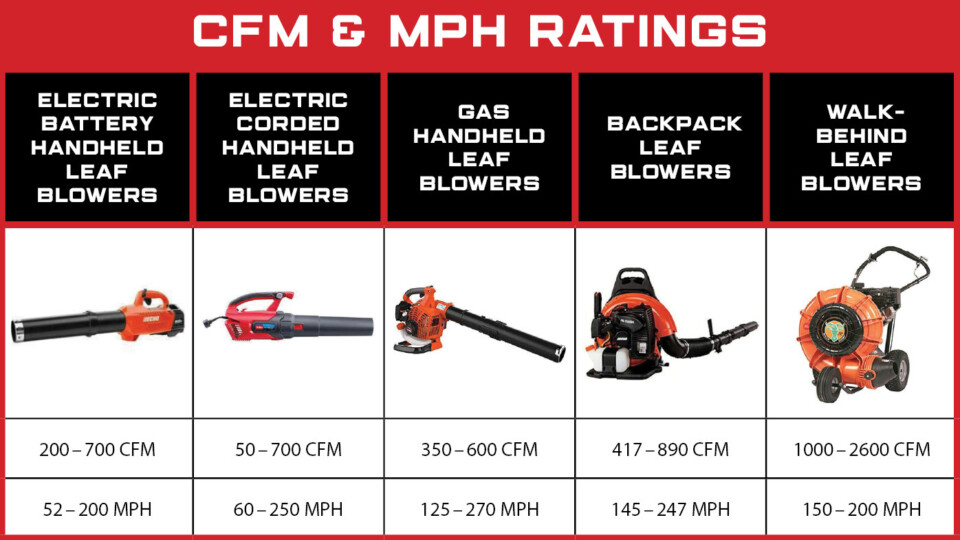
From my experience, a blower with about 150+ MPH and 400+ CFM can handle most homeowner tasks. For professional jobs, you’ll see numbers much higher, often over 200 MPH and 700+ CFM.

How to choose based on the job and blower type
Match the blower to the task. Here are practical guidelines:
- Quick cleanup on decks and driveways: prioritize MPH. Use a lightweight handheld model.
- Pushing medium piles and wet leaves: prioritize CFM. Choose a backpack or larger handheld blower.
- Large lawns, heavy piles, or professional work: choose high CFM and good MPH. Consider gas or high-capacity battery systems.
Battery vs gas trade-offs:
- Battery blowers are quieter and lighter. Good for 400–700 CFM range for modern high-end models.
- Gas blowers usually give higher CFM and longer run times, but they are heavier and louder.
Nozzle and design matter:
- Narrow nozzles boost MPH but can reduce effective CFM.
- Wide nozzles increase volume and make it easier to move piles.
From real tests, I found that using a wide nozzle on a high-CFM blower reduced the time to clear a yard by nearly half compared to a high-MPH narrow-nozzle model.
Limitations, measurement issues, and practical tips
Manufacturer specs can be misleading. Common issues:
- Test standards vary. Some brands quote theoretical peak MPH or CFM.
- Nozzle shape, measurement distance, and battery charge change numbers.
- Noise and vibration often increase with higher output.
Practical tips I learned:
- Test blowers in real conditions when possible before buying.
- Look for independent test data or user reviews that show real-world performance.
- Consider ergonomics and weight — a high-CFM blower you can’t hold will slow you down.
- Use technique: keep nozzle close for power, and step steadily to move piles efficiently.
What is the difference between MPH and CFM in leaf blowers? Remember that neither number alone guarantees performance. The blower design and how you use it matter as much as the specs.
Common mistakes to avoid
- Choosing only on MPH — you may struggle with heavy debris.
- Choosing only on CFM — you may not free stuck debris easily.
- Ignoring runtime and battery drain when you pick a high-output battery model.
- Overlooking attachments and nozzles that improve real-world results.
In my early days testing blowers, I picked a model with very high MPH expecting yard-wide performance. It worked great on dry leaves but failed on compacted, wet piles. That taught me to consider CFM and nozzle options first for heavy yards.
Frequently Asked Questions of What is the difference between MPH and CFM in leaf blowers?
What exactly does MPH tell me?
MPH measures the speed of the airflow at the nozzle tip. It indicates how forceful the air hits debris, which helps loosen stuck leaves.
What exactly does CFM tell me?
CFM measures the volume of air a blower moves per minute. Higher CFM means more air mass to carry leaves and piles away.
Is CFM more important than MPH for wet leaves?
Yes. Wet leaves are heavier, so volume (CFM) is typically more important to move them effectively.
Can a blower with low CFM but high MPH still work well?
It can work for light, dry debris and for loosening stuck material. For larger or heavy piles, it will be less effective.
How do battery and gas blowers compare on MPH and CFM?
Gas blowers often deliver higher sustained CFM and MPH for long jobs. Modern battery blowers can match these numbers for short runs and are quieter and lighter.
How should I choose a blower for a small yard?
For small yards, a lightweight handheld blower with moderate CFM and high MPH often works best for quick cleanups.
Do nozzle attachments affect MPH and CFM?
Yes. Narrow nozzles raise MPH but can reduce effective CFM. Wider nozzles increase volume and are better for moving piles.
Conclusion
Understanding the difference between MPH and CFM in leaf blowers helps you buy and use the right tool. MPH measures speed and helps break debris loose. CFM measures volume and moves debris away. Choose based on the job: high MPH for light surface cleaning, high CFM for heavy piles, and a balance for mixed tasks. Test models when possible, mind ergonomics, and use the right nozzle. Try these tips on your next yard cleanup and notice how much faster and easier the job becomes. If you found this helpful, leave a comment, subscribe for more gear guides, or test a few models and share your experience.

