

Need the straight answer? How many watts does a shop vacuum use? Most corded models draw between 780 and 1,800 running watts, with a typical mid-size unit landing near 1,200 watts.
The exact figure depends on the amp rating stamped on the motor nameplate.
Manufacturer specs tell the real story. A 10-amp shop vacuum on standard 120V US power pulls about 1,200 watts while running. A 6.5-amp unit uses roughly 780 watts, and a 15-amp heavy-duty model draws around 1,800 watts.
As of 2026, those numbers cover nearly every corded wet/dry vacuum on the market. The math matters because it decides whether your vacuum will trip a breaker, need a thicker extension cord, or run happily on a normal outlet.
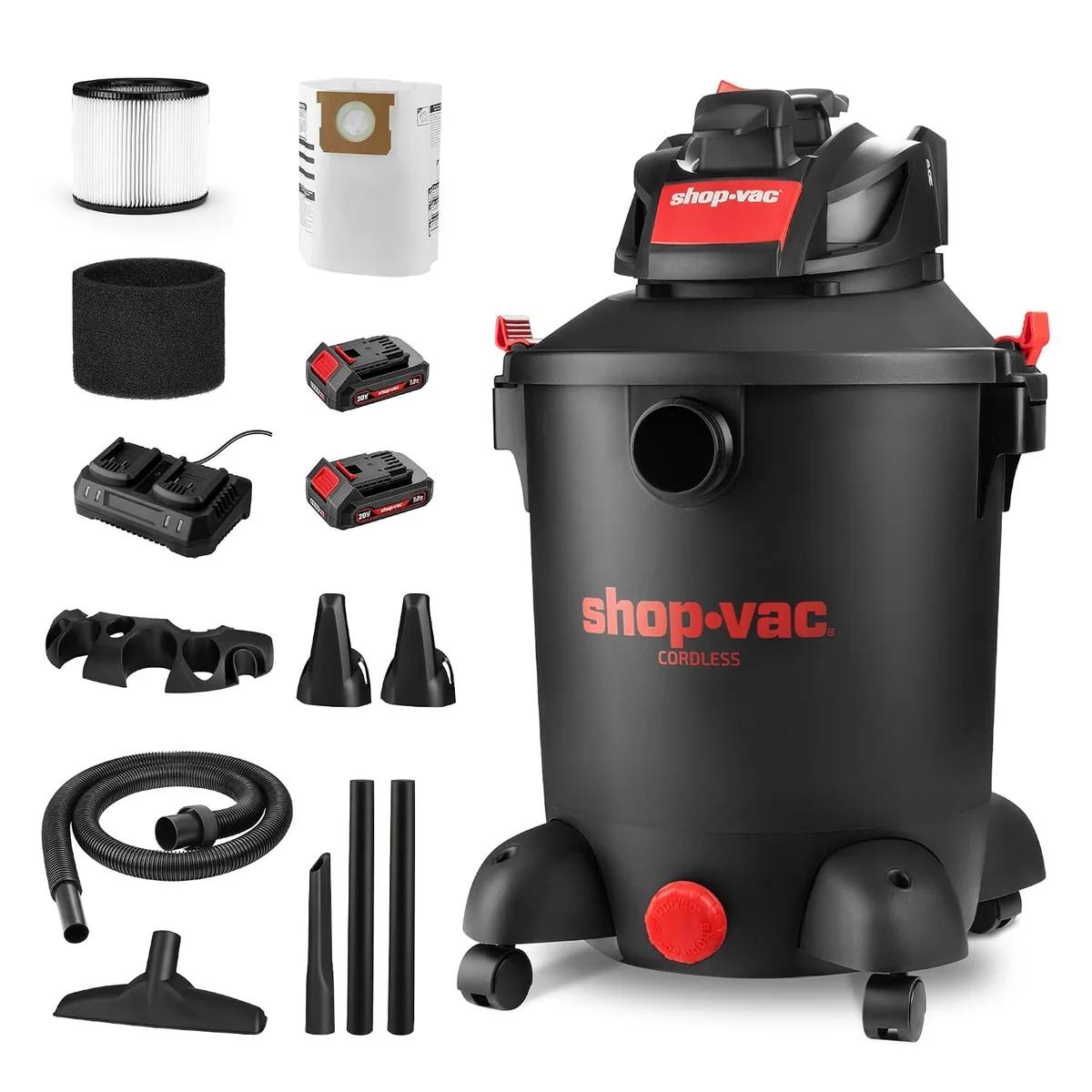
Image source: Web (Bing) / amazon.com (Web image (fair-use with source credit))
The Real Question: Why Shop Vac Wattage Confuses People
The short answer is easy. The long answer depends on your exact model, your home's electrical circuits, and what you ask the machine to do. That's why the wattage question deserves a careful look.
The confusion starts with peak horsepower. Manufacturers print "6.5 HP" or "7 Peak HP" on the box because the number sells machines. That rating comes from a brief, no-load motor spike with the motor spinning free.
It does not reflect what the vacuum draws during normal cleaning.
If you've ever wondered whether a "5 HP" shop vacuum can run on a standard bedroom outlet, you're asking the right question. The answer lives on the amp rating stamped into the motor. Your circuit, not the marketing box, decides what the machine can really do.
Quick Answer: Typical Wattage Ranges by Amperage
Most shop vacuums draw between 7 and 15 amps. At standard 120V household power, that's roughly 840 to 1,800 running watts. A typical mid-size unit uses about 1,200 watts.
The motor nameplate lists the true amp draw, and your exact wattage depends on that amperage multiplied by your voltage.
Running watts are the actual electrical load while the motor works under normal suction. Startup can briefly pull more current, but continuous draw is what matters for circuit planning.
| Amperage (120V) | Running Watts | Typical Use |
|---|---|---|
| 6.5A | ~780W | Light cleanup, small shop vacs |
| 8A | ~960W | Home garage, sawdust pickup |
| 10A | ~1,200W | Standard mid-size wet/dry vac |
| 12A | ~1,440W | Heavy home and workshop use |
| 15A | ~1,800W | Professional, nearly continuous duty |
If your vacuum lists watts instead of amps, use that number directly. If it lists only peak HP, ignore the hype and look for amps elsewhere on the nameplate.
The Simple Amps-to-Watts Formula (And Why It Matters)
The formula is one line: watts equal amps times volts. On a standard US household circuit, voltage is 120. A 10-amp vacuum motor therefore pulls 1,200 watts.
A 6.5-amp motor pulls 780 watts.
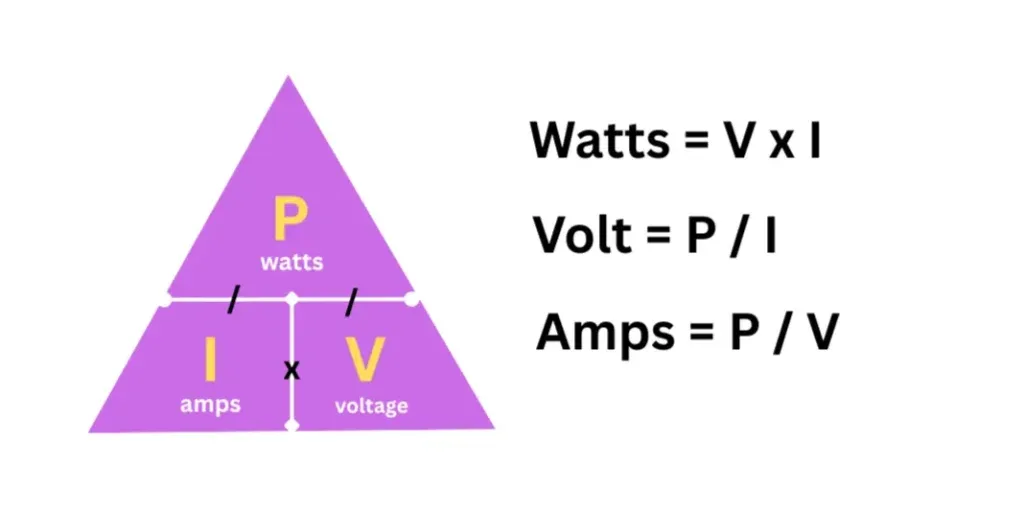
Image source: Web (Bing) / solderingmind.com (Web image (fair-use with source credit))
This matters for two reasons. First, wattage tells you how much electricity you pay for per hour of use. Second, it tells you whether the machine will trip your breaker.
A 15-amp vacuum running flat out on a 15-amp circuit is already at the limit.
International readers get a different picture. On a 230V standard, the same 1,200-watt motor draws only about 5.2 amps. That's why European shop vacuums often carry seemingly low amp ratings.
The wattage is the same, but the current is lower because the voltage is higher.
Peak Horsepower vs. Real Running Watts: The Marketing Trap
Peak horsepower is the marketing number, and it's mostly fiction. A "6.5 HP" wet/dry vac typically draws around 10 amps, which equals about 1,200 running watts. Real mechanical horsepower at the motor shaft would be closer to 1.6.
The box never tells you that.
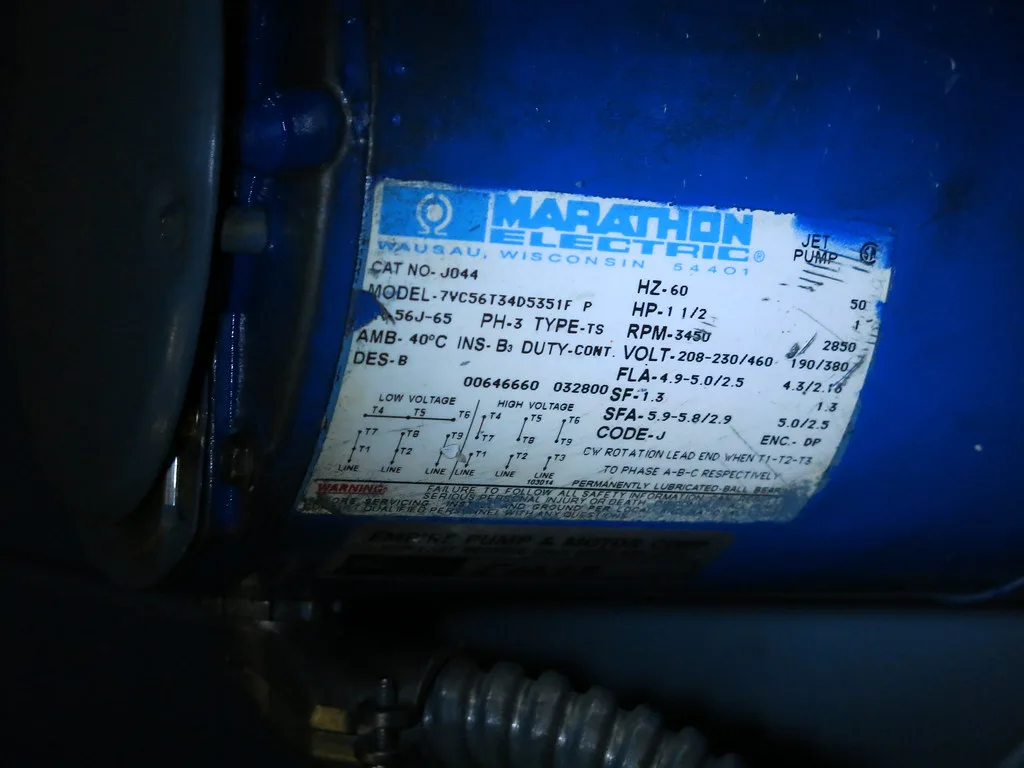
Image source: Bing (Web (fair-use with source credit))
Here's a better rule. Divide running watts by 745 and you get the mechanical horsepower equivalent. At 1,200 watts, that's roughly 1.6 HP.
That's still plenty for sawdust and wet spills, but it's nowhere near 6.5.
Manufacturer spec sheets confirm this gap. The amp rating is the trustworthy number for electricity use. Peak horsepower is the trustworthy number for selling machines.
| Marketing Label | Real Running Watts | Honest HP Equivalent |
|---|---|---|
| 4.5 Peak HP | ~840W | ~1.1 HP |
| 6.5 Peak HP | ~1,200W | ~1.6 HP |
| 7.0 Peak HP | ~1,440W | ~1.9 HP |
Decision Branches: Choosing by Your Situation
There is no single perfect wattage. The right number depends on how you use the vacuum and what your electrical system can handle.
Light Duty: Shop Dust and Sawdust
If you only grab the vacuum for a quick cleanup after a few cuts, a 6.5-amp to 8-amp model is plenty. That works out to roughly 780 to 960 watts. It handles sawdust, drywall dust, and scattered screws.
It also runs happily on any ordinary household circuit.
Best for: apartment workshops, small projects, and homeowners who need a garage clean-up tool.
Medium Duty: Renovation and Wet Spills
Burst pipe? Finished basement that flooded? That's the 10-amp to 12-amp zone, around 1,200 to 1,440 watts.
These units pull heavier debris and move water fast. They still run on a 15-amp circuit, but you usually need a 12-gauge extension cord and no other heavy loads sharing the line.
Best for: frequent renovation cleanup, shop users with dust-creating tools, and anyone managing water emergencies.
Heavy Duty: Continuous Professional Use
Contractors running a vacuum all day need the biggest motor that won't trip the panel. That means a 15-amp model at roughly 1,800 watts, often on a 20-amp dedicated circuit. If you use a vacuum as a dust extractor on a saw, this is the branch to read.
Best for: job sites, drywall crews, countertop fabricators, and serious woodshops.
Corded vs. Cordless: How Voltage Changes the Watts Story
Cordless shop vacuums are a different animal entirely. Instead of 120V wall power, they run on battery packs rated at 18, 20, or 36 volts. Wattage still equals amps times volts, but the printed numbers look much smaller.
A 36V battery pack delivering 15 amps produces 540 watts. That's less than even a low-wattage corded six-amp unit at 780 watts. Runtime drops fast under heavy load.
The tradeoff is portability, and for many home tasks a cordless unit is plenty.
A typical 20V cordless shop vacuum draws around 200 to 400 watts under normal use. A 5.0 amp-hour battery gives you roughly 30 to 60 minutes of actual cleaning, depending on the load. The numbers exist on any cordless tool, but they rarely get mentioned in the specs.
Specs at a Glance: Amp, Wattage, and Circuit Limits
Here is the summary table to bookmark.
| Vacuum Type | Typical Amps | Running Watts | Minimum Circuit |
|---|---|---|---|
| Small corded shop vac | 6.5A | ~780W | 15A household |
| Mid-size wet/dry vac | 10A | ~1,200W | 15A household |
| Large professional unit | 12A | ~1,440W | 15A with 12 AWG cord |
| Heavy-duty contractor unit | 15A | ~1,800W | 20A dedicated circuit |
The National Electrical Code says a continuous load should not exceed 80 percent of a circuit rating. On a 15-amp circuit, that means you should plan to draw no more than 12 amps continuously. A 15-amp vacuum therefore needs a 20-amp circuit, or at least one dedicated to the vac alone.
Per NFPA standards, that 80 percent rule also applies to the extension cord's ampacity. Most household circuits simply aren't sized for a big vacuum plus other tools at once.
What Wattage Actually Affects (And What It Doesn't)
Wattage affects one thing directly: the electrical power the motor consumes. It influences suction strength, but it's not the whole story. Airflow, measured in CFM, and water lift determine how fast a vacuum picks up debris and holds it in the tank.
Two vacuums at the same wattage can clean completely differently.
Higher wattage also gets you more noise, more heat, and faster battery drain if you're cordless. It does not automatically get you better filtration or a tougher hose.
A motor starved for airflow runs hotter and less efficiently. That's why a clogged filter kills performance. Once airflow drops, suction follows, but the motor keeps pulling the same wattage.
Clean filters keep the motor happy and the watts working.
Safety First: Circuit Limits, Extension Cords, and Wet Pickup
Wet pickup changes the safety picture. Water and electricity are a dangerous mix, so plug into a ground-fault circuit interrupter (GFCI) outlet whenever you're sucking up water. Most garages and basements built after the early 2000s already have them.
If yours doesn't, use a portable GFCI adapter or an extension cord with built-in protection.
Extension cords need a thick enough gauge for the amp draw. A 16-gauge cord is fine for a 6.5-amp vacuum over a short distance. A 15-amp vacuum needs at least a 12-gauge cord, and the shorter the better.
Thin cords overheat at high loads, especially on those drum reels sold at hardware stores.
OSHA guidance treats electrical safety on job sites seriously. GFCI protection, permanent wiring, and correctly rated cords are all part of workplace requirements for temporary power.
Common Mistakes to Avoid
- Trusting the peak HP sticker instead of the amp rating. It's marketing, not physics.
- Running a 15-amp vacuum on a circuit that's already feeding lights, a fridge, and power tools. Expect a tripped breaker.
- Using a thin 16-gauge extension cord on a high-draw vacuum. It heats up under load.
- Ignoring the filter until suction drops. A clogged filter raises the motor's workload and can overheat it.
- Letting a hose collapse under vacuum pressure when picking up wet debris. It starves the motor of airflow and slows pickup dramatically.
How to Check Your Exact Vacuum's Wattage in Two Minutes
Read the motor nameplate and multiply amps by volts. That's the whole process. Here's how it looks step by step.
- Unplug the vacuum. Find the silver or white nameplate on the motor housing, base, or under the tank.
- Write down the number next to "Amps" or "A." It's usually between 6 and 15.
- Multiply that by your mains voltage. In the US and Canada, that's 120V. In Europe, the UK, and Australia, it's 230V.
- The result is your running wattage. Round to the nearest hundred.
If you can't find the nameplate, check the owner's manual or the manufacturer's website. Spec sheets list amp draw for every current model. Older units and international versions may also list watts directly on the plate.
Choosing the Right Machine for Your Workshop
For most homeowners, a 10-amp model around 1,200 watts is the sweet spot. It handles wet and dry jobs, runs on any standard outlet, and doesn't strain your electrical system. If your workshop is on a 15-amp circuit, this is the safe ceiling.
If your space has older wiring or you share the garage circuit with a freezer, step down to an 8-amp unit. The suction loss is modest, and the breaker stays quiet. If you're a contractor, look for a 15-amp model and a dedicated 20-amp circuit.
That combination gives you the full power without the nuisance trips.
Maintenance That Keeps Suction Strong and Watts Honest
A shop vacuum's wattage stays the same, but its effective performance changes with maintenance. A clogged filter makes the motor work harder and move less air. Clean or replace the filter based on how dusty your work is, not just on a calendar schedule.
Check the hose for clogs, especially after picking up drywall dust or sawdust. Empty the tank before it reaches the full line. Wet debris left sitting in the tank breeds mold and cuts suction.
The same logic applies to every vacuum you own. Regular filter cleaning and clearing debris keeps the motor running cool and efficient. A well-maintained motor pulls the rated watts and turns them into real cleaning power.
Decision Guide: Match Your Needs, Not the Marketing Number
Let's pull this into one simple decision path.
If you need light cleanup and only have a 15-amp garage circuit, choose a 6.5A to 8A unit with a short 14-gauge cord. If you do renovation work or handle wet spills, choose a 10A to 12A unit and use a 12-gauge extension cord. If you run the vacuum all day as a dust extractor, skip cordless entirely and get a 15A model on a dedicated 20A circuit.
In every case, look at the amp nameplate first and the peak HP sticker second. That alone will keep you out of breaker trouble and give you the suction you actually pay for.
Frequently Asked Questions
Does higher wattage mean a shop vacuum has more suction?
Not necessarily. Wattage tells you how much electrical power the motor draws, but suction depends on motor design, fan efficiency, and airflow path. A well-designed 10-amp vacuum can outperform a sloppy 12-amp unit.
Check airflow (CFM) and water lift numbers for the real performance picture.
How many watts does a "6.5 HP" shop vacuum actually use?
Most "6.5 HP" wet/dry vacuums run on about 10 amps. On 120V, that's roughly 1,200 running watts. The honest mechanical horsepower equivalent is around 1.6 HP.
The "6.5" label is a no-load peak number measured in ideal conditions, not real-world cleaning power.
Can I run a shop vacuum on a standard 15-amp household circuit?
Yes, as long as the vacuum draws 12 amps or less and nothing else heavy is running on the same circuit. A 15-amp vacuum on a 15-amp circuit is pushing the limits. Give it a dedicated circuit or a 20-amp breaker for continuous work.
A 10-amp vacuum leaves comfortable headroom.
Is 1,200 watts enough for a shop vacuum?
Yes, for most home and workshop jobs. 1,200 watts means about 10 amps at 120V, which handles sawdust, drywall dust, water spills, and most renovation debris. It's the same power level as a mid-size wet/dry vac from most major manufacturers. Heavy continuous extraction is the only case where you'd want more.
Why does my shop vacuum keep tripping the breaker?
Usually because the total load on that circuit exceeds 15 amps. Add up the vacuum, lights, a fridge, or power tools sharing the same line. If the vacuum draws 12 amps or more, it can trip a breaker on its own.
Use a dedicated circuit and a thicker extension cord.

