

Darts has become much more than a casual pub game. Today, it’s a precision sport with international tournaments, professional leagues, and strict standards. But if you’re setting up your own board at home or for a club, a common question comes up: What is the regulation distance from a dart board? Getting this right isn’t just about fairness. It’s about building good habits, enjoying the game more, and even preparing for competitive play.
This guide explains everything you need to know about regulation dart board distance, including differences between steel tip and soft tip darts, how to measure accurately, and common mistakes to avoid. You’ll also find clear tables, practical tips, and answers to the most frequent questions.
Understanding Regulation Dart Board Distance
The regulation distance means the official, recognized measurement that all players must follow. This standard comes from two main organizations: the World Darts Federation (WDF) and the Professional Darts Corporation (PDC). These groups set the rules for most tournaments worldwide.
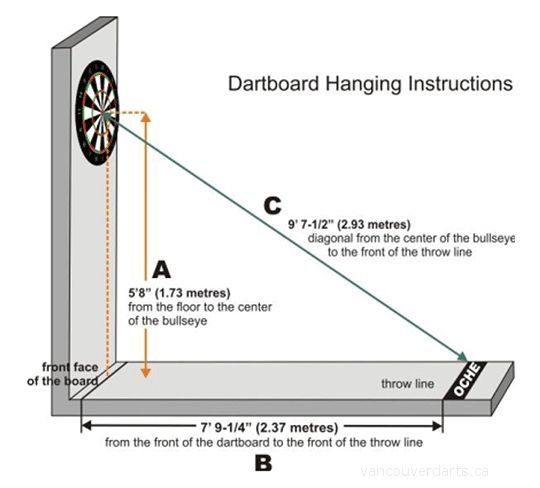
For a standard steel tip dart game, the regulation distance is measured from the front face of the dartboard (not the wall) to the throwing line (also known as the “oche”). The exact numbers matter, so let’s look at them closely.
Official Measurements For Steel Tip Darts
Most traditional dartboards use steel tip darts. The two main measurements you need are:
- Bullseye height: The center of the bullseye should be exactly 5 feet 8 inches (1.73 meters) from the floor.
- Throwing distance: The oche should be 7 feet 9.25 inches (2.37 meters) from the face of the board, measured horizontally along the floor.
Here’s a handy comparison table for quick reference:
| Measurement | Imperial Units | Metric Units |
|---|---|---|
| Bullseye Height | 5 ft 8 in | 1.73 m |
| Throwing Distance (Oche) | 7 ft 9.25 in | 2.37 m |
Why These Exact Numbers?
The measurements are not random. The height of 5’8” matches the average eye level of an adult, which keeps things fair for most players. The horizontal distance is based on years of tradition and makes sure the game is neither too easy nor too hard.
Differences For Soft Tip Darts
Soft tip darts are common in North America and Asia, and the boards are electronic. The rules are almost the same, but there is a small change in the throwing distance.
- Throwing distance for soft tip darts: 8 feet (2.44 meters) from the face of the board.
Bullseye height remains at 5 feet 8 inches (1. 73 meters).
Compare the two styles:
| Type | Bullseye Height | Throwing Distance |
|---|---|---|
| Steel Tip | 5 ft 8 in (1.73 m) | 7 ft 9.25 in (2.37 m) |
| Soft Tip | 5 ft 8 in (1.73 m) | 8 ft (2.44 m) |
Non-obvious insight: The small difference in distance for soft tip darts is because these boards are less sensitive to bounce-outs, and the lighter darts can travel a bit farther without losing accuracy.
How To Measure Dart Board Distance Accurately
Setting up your board with the right measurements is essential for fair play. Here’s a practical step-by-step method:
- Mark the bullseye height: Use a tape measure to mark 5’8” (1.73 m) from the floor, and install the board so the bullseye is exactly at this point.
- Find the oche (throw line): Measure 7’9.25” (2.37 m) for steel tip or 8’ (2.44 m) for soft tip from the face of the board along the floor—not the wall.
- Mark the line: Use masking tape, a thin wooden strip, or a special “oche” marker to show where you must stand.
- Double-check angles: The measurement must be horizontal—don’t measure at an angle from the board to the floor. A simple way: use two people and a string, or a laser level.
Common Mistakes When Measuring
Many beginners make small errors that can change the game experience. Watch out for:
- Measuring from the wall instead of the board’s face. If your board is thick or mounted away from the wall, this mistake can reduce the distance by several inches.
- Measuring at an angle (diagonal). The official rule is along the floor, not diagonally.
- Not using a level or measuring tape. Guessing the height or distance is unreliable.
- Ignoring uneven floors. If your floor slopes, the bullseye height may be off. Always measure up from the spot where you’ll stand.
Non-obvious insight: Even a half-inch mistake makes a real difference in darts. If you practice at the wrong distance, your aim will feel off in a tournament.
Additional Space And Room Requirements
A regulation setup isn’t just about distance. You also need enough space to throw safely and comfortably.
- Clear throwing area: At least 5 feet (1.5 meters) wide, so players can move freely.
- Safe zone behind the oche: Ideally 3 feet (1 meter) or more, so others can pass behind the thrower without interfering.
- Wall protection: Place a backing or cabinet around the board to protect your walls from missed darts.
- Lighting: Make sure the area is well-lit. Shadows on the board can affect accuracy.
Example Room Layout
Here’s a quick layout for a standard home dart setup:
| Element | Recommended Minimum Size |
|---|---|
| Width of Play Area | 5 ft (1.5 m) |
| Distance from Board to Throw Line | 7 ft 9.25 in – 8 ft (2.37 – 2.44 m) |
| Space Behind Throw Line | 3 ft (1 m) |
| Total Recommended Length | 11 ft (3.35 m) |
If you have less room, you can still play, but the experience may not feel authentic.
Why Regulation Distance Matters
Using the correct distance is more than tradition. Here’s why it’s important:
- Consistency: Practicing at regulation distance builds muscle memory. If you play in a pub, league, or tournament, you’ll be ready.
- Fairness: Everyone plays with the same challenge. A shorter distance makes high scores easier, but it’s not real darts.
- Skill development: Proper distance encourages better aiming and smooth throwing technique.
- Injury prevention: Standing too close can cause overreaching, which may lead to shoulder or elbow pain.
Practical tip: If you want to improve quickly, always use regulation distance—even for fun games at home.
Regional Differences And Special Rules
While most countries follow WDF and PDC standards, a few local leagues have their own rules. For example:
- Some older UK pubs use a “London” board with a slightly different setup.
- Youth leagues may move the oche closer for kids.
- Disabled leagues sometimes allow custom distances for wheelchair players.
If you want to join a league or play in another country, check the local rules first. But for most players, the international standards are the best guide.
Helpful Tools For Setting Up
To make setup easier, consider these tools:
- Dart mat: A rubber or carpet mat with distance markers. Just roll it out and place the oche line where shown.
- Laser oche: A small device that projects a bright line on the floor at the correct distance.
- Wall mount kits: Some kits come with adjustable brackets and clear measurement guides for quick, accurate installation.
Some players use smartphone apps with augmented reality, but these are less reliable than physical measuring tools.

Measuring Diagonal Distance (alternate Method)
You might see rules mentioning a “diagonal” distance—from the bullseye to the oche, not along the floor. This is sometimes used as a double-check.
- Diagonal distance (steel tip): 9 feet 7.5 inches (2.93 meters).
To use this, measure from the center of the bullseye (on the board) diagonally to the floor at the oche line. This only works if your bullseye height and floor distance are correct.
Practical tip: Use diagonal measurement as a final check, but always set up your board using the horizontal and vertical numbers first.
Setting Up For Left- Or Right-handed Players
Some people worry if they need a different setup for left- or right-handed throwers. The answer is simple: the regulation distance is the same for everyone. Just make sure the area is wide enough for comfortable arm movement.
What About Multi-use Rooms?
Many people set up dartboards in garages, basements, or living rooms. If you share the space, try these ideas:
- Use a portable stand, so you can move the board when not in use.
- Choose a foldable oche marker or removable tape.
- Add a cabinet or backboard to catch stray darts and avoid wall damage.
When And How To Adjust Distance
The only time you should adjust the distance is for:
- Children: Move the oche closer to build confidence, then gradually increase as skills improve.
- Beginners: Some new players start at 7 feet, but should switch to regulation as soon as possible.
- Adaptive play: For people with disabilities, measure from their natural throwing position.
Otherwise, stick to the official numbers.

Final Thoughts
Setting up your dartboard at the proper regulation distance is the foundation for fair, skillful play. Whether you’re practicing for a tournament or just enjoying a friendly game at home, small details like accurate measurements make a big difference. Use the guidance and tables above to get your setup right, and you’ll enjoy the true spirit of darts—precision, challenge, and fun.
For more on official dart rules and equipment, check out the Wikipedia Darts page.
Frequently Asked Questions
What Is The Standard Height For A Dartboard?
The standard bullseye height is 5 feet 8 inches (1.73 meters) from the floor to the center of the bullseye.
How Far Should I Stand From A Dartboard For Steel Tip Darts?
For steel tip darts, stand 7 feet 9.25 inches (2.37 meters) from the face of the board, measured horizontally along the floor.
Is The Distance Different For Soft Tip Darts?
Yes, for soft tip darts, the distance is 8 feet (2.44 meters) from the face of the board to the oche.
Can I Use A Laser Oche Or Dart Mat For Measurement?
Absolutely. A laser oche or dart mat with distance markers makes setup quick and accurate.
Why Does Accuracy In Measuring Matter For Darts?
Accuracy ensures fair play and helps you build correct technique. Practicing at the wrong distance can harm your performance in real games.

