

What size shop vacuum should I buy? Most people answer that question by guessing, and most people end up with a tank that's either too small to be useful or too big to store anywhere. The real answer depends on three things: where you'll stash it, what you'll clean with it, and how often you're willing to empty the tank.
Manufacturer specifications confirm that tank volume alone doesn't predict cleaning performance. The numbers that really matter are CFM, which measures airflow, and water lift, which measures suction strength. As of 2026, even budget wet/dry vacuums have closed the horsepower gap, so sizing is a logistics decision more than a power decision.
Let's work through your situation step by step.
Image source: Web (Bing) / storage.googleapis.com (Web image (fair-use with source credit))
Why Shop Vacuum Size Matters More Than You Think
Size determines whether a shop vacuum earns its garage space or becomes a dust-collector itself. A 5-gallon portable is agile, but it fills up mid-project. A 20-gallon behemoth saves trips to the dump, yet you'll dread dragging it out for small messes.
How many times will you actually wheel it out? That's the question nobody asks. A 20-gallon unit in a two-car garage sounds practical until you realize it takes up half a shelf and both hands to move.
A 6-gallon model weighs under 20 pounds, and the tradeoff shows up fast: more empty cycles, way more convenience.
The opposite problem strikes small-tank owners who do serious work. They buy a 2.5-gallon bucket vac for the kitchen, then try to use it on renovation dust. It clogs, heats up, and frustrates.
That's how a bargain becomes a second purchase within a year.
Think through your conditions honestly:
- Storage: measure the cabinet, shelf, or corner where it's going to live.
- Debris volume: how many gallons of junk do you actually produce per job?
- Portability: are you moving it between rooms, into a car, or down stairs?
These three variables are the whole game. In our research, buyers who regret their purchase almost always skipped this logic. They picked a tank size off a shelf without checking whether it fits their garage, their projects, or their back.
The Quick Answer: What Size Do Most Homeowners Need?
Most homeowners should buy a 10- to 14-gallon wet/dry vacuum. That size balances capacity, footprint, and suction. It handles a flooded corner or a full workshop cleanup.
And it still fits under a workbench.
| Household profile | Recommended size | Reasoning |
|---|---|---|
| Apartment or small car | 2-5 gallons | Easy storage, light jobs |
| Typical garage | 10-14 gallons | Best all-around balance |
| Heavy workshop | 16-20 gallons | Fewer empty cycles |
| Contractor or job site | 12-16 gallons | Portable but powerful |
Aggregate reviews from thousands of owner reports tell the same story. The common mistake isn't buying too little power, it's buying too much bulk. A mid-size tank with a longer hose gets used far more often than a giant one you never roll out.
If you're weighing extra features like built-in lights or tool storage, that's fine. Just don't let those distract you from the fundamental size decision.
How Shop Vac Sizing Actually Works: Gallons, CFM, and Water Lift
Tank size gets all the attention, but the real performance trio is:
- Gallons: how much debris you can collect before emptying.
- CFM (cubic feet per minute): the volume of airflow moving through the hose.
- Water lift (inches of H₂O): static suction, which handles heavy or wet material.
Manufacturer spec sheets list all three, yet most shoppers fixate on horsepower. Ignore that number. Peak horsepower is measured at the motor with no hose attached, so it overstates what you'll feel at the nozzle.
For real-world cleaning, look for at least 90 CFM and 60 inches of water lift. That combination handles sawdust, spilled water, and small debris without drama.
Here's a visual that makes the airflow concept click:
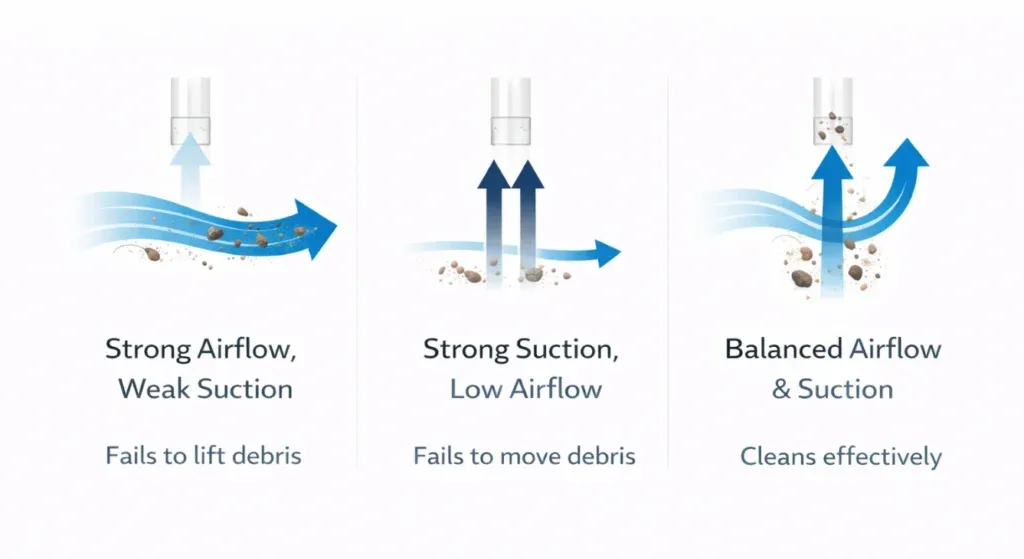
Image source: Web (Bing) / clenixlab.com (Web image (fair-use with source credit))
Think of airflow and suction as a team. Airflow moves dirt along the hose. Suction holds it in place.
A vacuum with high water lift but low CFM will pin a wood chip to the floor instead of lifting it. One with high CFM but low water lift will scatter debris across the room.
Hose diameter shifts the math, too. A 1.5-inch hose moves fewer cubic feet per minute than a 2.5-inch hose, even on the same motor. If you're picking a big tank, confirm the hose size as well.
The two go hand in hand.
Filters complicate things further. A clogged cartridge drops both CFM and water lift fast. That's why you'll notice a shop vac start losing suction fast when it's overdue for a cleaning.
Per OSHA, fine dust exposure is a real concern on renovation projects, so cartridge quality and lid seal matter more than tank volume.
The Size Classes Defined: Portable, Mid-Size, and Full-Size
Shop vacuums sort into three practical classes, and each one carries a tradeoff between capacity, portability, and suction.
Portable Wet/Dry Vacs (2-5 gallons)
These are the bucket-sized units you can grip with one hand. They shine in car interiors, RV cleanouts, and quick household spills. Most cordless models live in this class, which helps when you're working far from an outlet.
They don't hold much, but the short hose keeps them free from the hose collapse issues that plague cheap long-hose setups.
Mid-Size Vacs (6-12 gallons)
This is the workhorse range for homeowners. Units in this class tuck into closets and under workbenches, accept full-size accessory kits, and handle wet spills without flooding. An 8- to 10-gallon model typically weighs 15 to 25 pounds, which most adults can manage comfortably.
Full-Size Vacs (14-20+ gallons)
These are serious shop tools. They hold a full bucket's worth of water before needing a drain, and their motors push high airflow through long hoses. The tradeoff is a 30-plus-pound frame that eats floor space.
If you have room to park it and jobs that fill it, this class earns its place.
| Class | Capacity | Best for | Tradeoff |
|---|---|---|---|
| Portable | 2-5 gal | Detailing, small spills | Constant emptying |
| Mid-size | 6-12 gal | General garage work | Limited flood capacity |
| Full-size | 14-20+ gal | Workshops, flooding | Heavy and hard to store |
Here's the if/then decision: if your messes fit in a trash bag and you clean up once a week, a mid-size tank wins. If you generate a full refuse bin of shavings or your basement takes on water, go full-size. A portable is rarely the right first shop vacuum, but it makes a fantastic second one for car work.
Match the Tank to the Mess: Workshop, Auto, and Wet Spill Scenarios
Mess type is the strongest predictor of tank size. Let's break it down by what you're actually cleaning.
Workshop and Construction Cleanup
Drywall dust, wood shavings, and dropped fasteners fill tanks fast. Drywall chunks and scrap lumber behave exactly like heavy debris loads that clog undersized hoses. A 10-gallon tank empties after about three full buckets of loose debris.
That's fine for weekend builders. For daily saw use, a 16-gallon model saves you from hauling to the trash every evening.
Auto Detailing
Cars produce fine dust and small particles, so tank capacity isn't your bottleneck. A 5- to 8-gallon portable with strong CFM and a crevice tool kit beats a bulky full-size unit parked across the garage. The limiting factor is hose reach, not tank volume.
Wet Messes and Flooding
A flooded basement can dump 10-plus gallons of water before you notice progress. A 5-gallon tank forces endless trips outside to drain. A 16-gallon unit with a drain port empties through a floor drain or into the yard without lifting the lid.
Image source: Web (Bing) / adgweldingsupplies.com.au (Web image (fair-use with source credit))
Here's how the decision tree branches:
If you clean a car monthly → buy portable.
If you do weekend woodworking → buy 10- to 12-gallon mid-size.
If you're finishing a basement or water creeps near your storage shelves → buy 16 gallons plus.
Real-world example: a homeowner with a four-car garage, a table saw, and a toddler who spills juice daily. That's a 12- to 14-gallon unit with a HEPA filter and a drain port. It handles Saturday's sawdust pile and Tuesday's juice spill without missing a beat.
A renter in a studio apartment has no business with a 16-gallon tank. A 4-gallon portable with a decent hose and a wet/dry filter switch is the right call there.
One more thing about wet pickup: it demands a clean, dry filter path. Keeping filters clean is the habit that prevents mildew smells and clogs. The EPA also recommends a HEPA-rated filter when you're cleaning up fine particulates like drywall dust, since standard filters re-circulate the stuff you're trying to remove.
Corded vs. Cordless: When Portability Overrides Tank Size
Cordless shop vacuums top out around 5 gallons. With a cord, capacity ranges from 5 to 20 gallons. That split tells the story.
If your projects happen in the driveway, attic, or a spot with no accessible outlet, portability wins. A 4-gallon cordless model is easier to cart around than any 10-gallon corded unit. You trade tank volume for reach and convenience.
But a cordless motor runs on battery voltage, which peaks lower than wall power. Aggregate reviews show cordless units deliver roughly 30 percent less airflow than comparable corded models. For light cleanup and car interiors, that's fine.
For deep flood pickup, you'll need the cord.
Decision logic: if the mess is usually within 20 feet of an outlet, get a corded mid-size tank. If the mess moves around a property, a cordless portable beats any tank size on pure convenience.
Step-by-Step: How to Measure Your Space and Estimate Debris Volume
Step one: find the parking spot. Measure width, height, and depth of the shelf, cabinet, or corner where the vacuum will live. A 16-gallon model is often 22 inches tall and 18 inches wide.
A 5-gallon model is roughly half that. Pick the tank that fits before you think about anything else.
Step two: estimate a typical mess. Fill a trash bucket with sawdust, leaves, or debris. If one full bucket covers the job, a 5-gallon tank works.
If you produce two or three buckets, go to 10 or 12 gallons. For wet jobs, remember one gallon of water weighs 8.3 pounds. A 16-gallon tank full of water gets seriously heavy.
Step three: check the doorways and stairs on your route. If the vacuum has to travel, a wheeled 12-gallon model with a 1.5-inch hose is the sweet spot for most garages. Large-capacity setups tend to stay parked where they're stored.
Common Sizing Mistakes That Waste Money and Clutter Garages
Shoppers routinely repeat the same five mistakes. Avoid them and you'll buy right the first time.
- Buying too large for storage space. A 20-gallon tank that lives in the middle of the garage floor is a hazard. Measure first.
- Picking by horsepower instead of fit. Peak horsepower numbers come from the motor, not the nozzle. They don't predict real cleaning.
- Ignoring the hose diameter. A tiny 1.5-inch hose chokes a big motor. A 2.5-inch hose moves twice the debris volume.
- Missing the filter maintenance cost. If you clean drywall dust, budget for a HEPA cartridge. Standard filters clog fast and need replacement.
- Choosing a cordless model for basement flooding. A cordless vac won't run long enough to clear standing water on one charge.
Each of these mistakes leads to a second purchase. Regular upkeep of filters and hoses is what keeps any wet/dry vac running right for years.
What Each Size Class Costs: Real Price Ranges
| Tank class | Typical price range | What you usually get |
|---|---|---|
| 2-5 gallons | $50 to $110 | Basic filters, short hose, no drain port |
| 6-12 gallons | $80 to $220 | Better filters, longer hose, tool adapters |
| 14-20 gallons | $150 to $400+ | Drain ports, large caster wheels, blower mode |
Prices reflect the hardware, not the brand name alone. Cheap units under $80 often ship with a fabric filter that soaks up wet debris poorly. Mid-range options include cartridge filters and a drain port, which are worth the upgrade if you ever pick up water.
Accessories push costs higher. A wall-mount kit runs $30 to $60. Extension wands and crevice tool sets add another $20 to $40.
And if you work with fine dust, a HEPA cartridge replacement can run $30 to $60 each. Factor those into the total budget before you buy.
Expert Tips: Hoses, Filters, and Accessories That Change Your Sizing Math
Hose choice matters more than tank size. A long hose saves you from moving the tank, but it also reduces suction. A 10-foot hose with a 2.5-inch diameter keeps airflow healthy.
A 20-foot hose demands a bigger motor to match.
Filters control how often you stop. A standard cartridge works for sawdust and wood chips. A HEPA-rated filter captures the ultrafine particles found in drywall dust and soot.
If you're cleaning up a renovation, per manufacturer documentation and U.S. EPA guidance, choose a HEPA filter specifically for that task.
Think about tool connectivity before finalizing. Many mid-size vacs accept a 1.5-inch accessory kit that plugs into power tools. That setup turns one machine into a dust collector for a saw or sander, but it adds to the size of the kit you own.
Count the accessories in your space planning, not just the tank. The same storage discipline that keeps long hoses manageable applies here.
Maintenance: Keeping Your Shop Vac Ready for the Next Big Mess
A shop vacuum only works well when the filter is clean and the tank is empty. After every wet pickup, drain the tank, rinse it, and let it dry completely. That prevents mildew smells and rust, especially on steel tanks.
For dry dust, tap the cartridge filter outside or rinse it with water every few full tanks. Filters that stay clogged cut airflow by half, and you'll blame the motor when the filter is the problem. Replace the cartridge when it tears or after heavy drywall cleanup.
Keeping the hose clear and the lid seal intact matters just as much. A cheap fix now beats a replacement purchase later.
FAQs: Answering What Shoppers Ask Most
What size shop vacuum do I need for home use?
A 10- to 14-gallon wet/dry vacuum covers nearly every household job, from car interiors to garage dust. It stores under a workbench and empties easily. Pick 10 gallons if you clean weekly, 14 gallons if you tackle renovations.
Is a 5-gallon shop vacuum worth buying?
A 5-gallon model makes sense for apartments, small cars, and light dust. It fills fast on big jobs, so you'll empty it often. Use it as a second vacuum if you already own a larger tank.
Does higher horsepower mean better suction?
No. Peak horsepower numbers come from the motor with no hose attached. Look for CFM and water lift instead.
Around 90 CFM and 60 inches of water lift handles most home debris.
Can a shop vacuum pick up water?
Yes, if you remove the dry filter and use the included foam sleeve or wet-rated filter. A tank with a drain port makes liquid disposal far easier. Never leave standing water in a steel tank overnight.
Final Decision Guide: Which Shop Vac Size Should You Buy?
Walk through these conditions in order. Storage space first, then debris volume, then how often you'll use it.
If space is tight and jobs are light, buy a 5-gallon portable. If you have a typical garage or workshop, choose a 10- to 14-gallon mid-size unit with a 1.5-inch hose. If you deal with flooding or daily sawdust, step up to a 16-gallon model with a drain port and HEPA filter.
Match the tank to your messes, not to a display case. That's the whole secret. Buy the size that fits your space and gets used, and it'll stay ready for years.

