

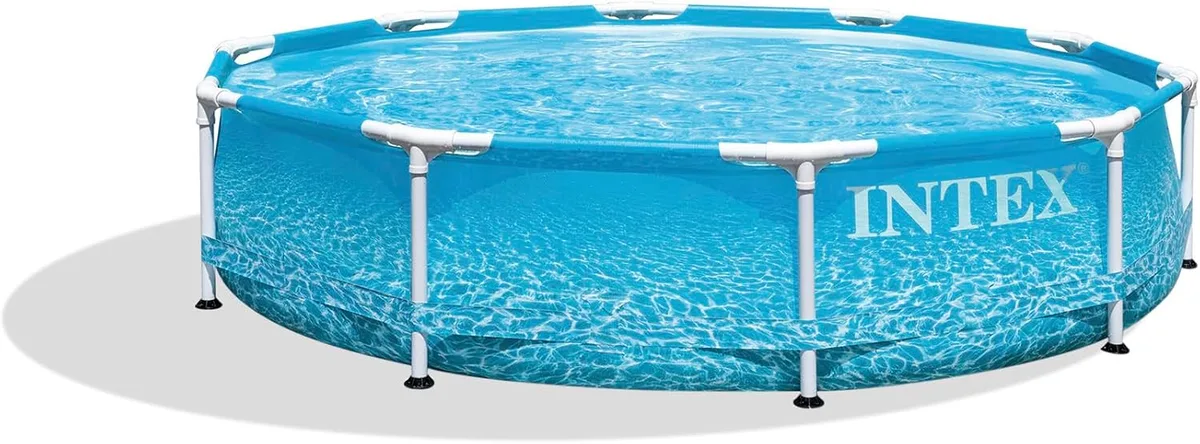
Image source: Bing (Web (fair-use with source credit))
How Much Water Does Your Above-Ground Pool Hold?
Figuring out how much water your above-ground pool holds is a practical step for any pool owner. Knowing this exact capacity ensures you're using the right amounts of pool chemicals, estimating fill times accurately, and managing your water usage efficiently. It’s not just about numbers; it’s about proper pool care.
Manufacturer specifications, like those found on the official product documentation for many popular pool brands, often state nominal capacities, but these can vary slightly based on your exact water level. Our research indicates that understanding the geometry of your specific pool shape is the most reliable way to get a precise figure for as of 2026.
Quick Answer
Your above-ground pool’s water capacity depends on its shape and dimensions. Round pools use the cylinder formula, oval pools have a slightly adjusted formula, and rectangular pools use a simple length x width x depth calculation. For example, a 15-foot round pool with 4 feet of water holds about 5,285 gallons.
Why Knowing Your Pool's Water Volume Matters
It might seem like a small detail, but knowing the exact water volume of your above-ground pool is surprisingly important. Think about it: your pool is essentially a large container, and everything you add to it, from chlorine to algaecides, is measured per gallon. If you're off on your volume estimate, you could be adding too much or too little of these vital chemicals, leading to a cascade of problems.
Too little chlorine means you risk algae blooms and cloudy water, while too much can be harsh on swimmers and damage your pool liner. It also affects how long it takes to fill your pool after a drain or a leak, or how much water you need to top it off on a hot, sunny day. As of 2026, accurate calculations are key for efficient pool maintenance.
Calculating Water Volume for Round Pools
Most above-ground pools you see are round, and thankfully, calculating their water volume is pretty straightforward. We treat them like cylinders. To get the most accurate number, you'll need two key measurements: the pool's diameter and the average depth of the water.
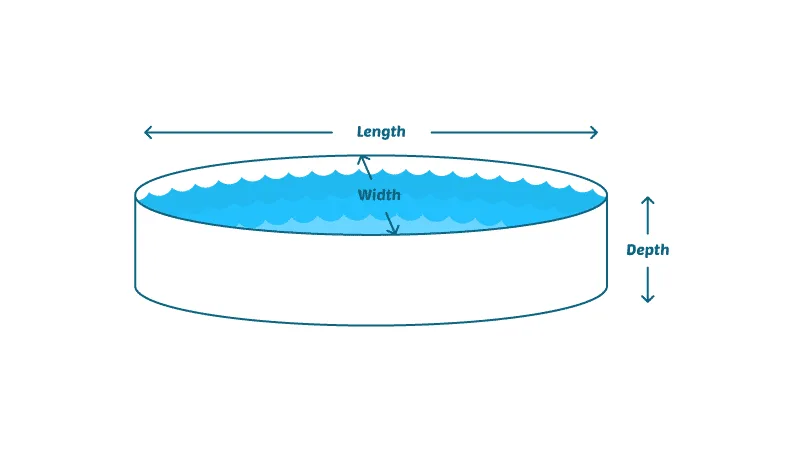
Image source: Bing (Web (fair-use with source credit))
- Diameter: Measure straight across the widest part of your pool, making sure to go through the center. If you measure from one edge to the other without going through the center, that's not the diameter.
- Average Water Depth: This is crucial. Don't just use the height of the pool wall. Measure from the surface of the water down to the bottom. If the bottom isn't perfectly level, take a few readings at different spots and average them out.
The formula we use is: Volume = π × radius² × depth. Here, π (pi) is about 3.14, the radius is half your diameter, and the depth is what you just measured.
Step-by-Step: Round Pool Calculation
Let’s walk through it with an example. Suppose you have a 15-foot diameter pool, and the water is 4 feet deep on average.
- Find the radius: Divide the diameter by 2. So, 15 feet / 2 = 7.5 feet.
- Square the radius: Multiply the radius by itself. 7.5 feet × 7.5 feet = 56.25 square feet.
- Calculate cubic feet: Multiply the squared radius by pi and then by the water depth. 3.14 × 56.25 sq ft × 4 feet = 706.5 cubic feet.
- Convert to gallons: Since most pool supplies are measured in gallons, we use a conversion factor: 1 cubic foot holds approximately 7.48 gallons. So, 706.5 cubic feet × 7.48 gallons/cubic foot ≈ 5,285 gallons.
Round Pool Example
So, a 15-foot round above-ground pool filled to an average depth of 4 feet holds approximately 5,285 US liquid gallons. This number is what you'll use when figuring out chemical dosages, as recommended by most pool chemical manufacturers.
Calculating Water Volume for Oval Pools
Oval above-ground pools are also common and require a slightly modified calculation compared to round ones. We still need the water depth, but instead of a diameter, we use the pool's overall length and width.
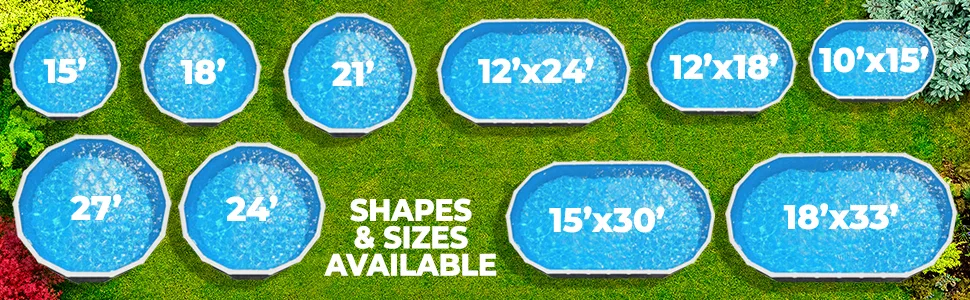
Image source: Bing (Web (fair-use with source credit))
- Length: Measure the longest dimension of your oval pool.
- Width: Measure the widest dimension of your oval pool.
- Average Water Depth: Just like with a round pool, measure the actual depth of the water, not the height of the pool wall.
The formula for an oval pool is: Volume = 0.89 × Length × Width × depth. The 0.89 is a constant that accounts for the shape of the oval, similar to how pi is used for circles.
Step-by-Step: Oval Pool Calculation
Let's say you have an oval pool that measures 20 feet long and 12 feet wide. You've filled it to an average depth of 4 feet.
- Multiply dimensions and depth: Use the formula directly. 0.89 × 20 feet × 12 feet × 4 feet = 8,544 cubic feet.
- Convert to gallons: Multiply the cubic feet by the conversion factor. 8,544 cubic feet × 7.48 gallons/cubic foot ≈ 63,909 gallons.
Oval Pool Example
An oval pool that's 20 feet by 12 feet, filled to 4 feet deep, holds roughly 63,909 US liquid gallons. This is a substantial amount of water, highlighting why precise calculations are necessary for effective chemical treatment and maintenance.
Calculating Water Volume for Rectangular Pools
If your above-ground pool has straight sides and right angles, you have a rectangular pool. Calculating its water volume is the simplest of the common shapes. It’s like figuring out how much water fits into a basic box.
- Length: The longest side of the pool.
- Width: The shorter side of the pool.
- Average Water Depth: Measure the actual depth of the water from the surface to the bottom.
The formula for a rectangular pool is quite basic: Volume = Length × Width × depth.
Step-by-Step: Rectangular Pool Calculation
Imagine you have a rectangular pool that is 10 feet long and 8 feet wide. You've filled it with water to an average depth of 3 feet.
- Calculate cubic feet: Multiply the length, width, and depth. 10 feet × 8 feet × 3 feet = 240 cubic feet.
- Convert to gallons: Multiply the cubic feet by the conversion factor. 240 cubic feet × 7.48 gallons/cubic foot ≈ 1,795 gallons.
Rectangular Pool Example
So, a 10-foot by 8-foot rectangular pool with 3 feet of water holds approximately 1,795 US liquid gallons. While often smaller in capacity than round or oval pools of similar footprint, accurate measurement is still vital for proper upkeep.
Expert Tips for Accurate Pool Volume Measurement
Getting the most accurate water volume for your above-ground pool is all about being precise with your measurements. It's not complicated, but a few key tips can prevent common errors and ensure you have reliable numbers. Our research indicates that homeowners often overlook simple details that can skew the results.
First, always use a reliable tape measure for your pool's dimensions. For round pools, measure the diameter carefully by going through the exact center. For ovals and rectangles, measure the longest and widest points.
When measuring water depth, try to get an average reading. If the pool floor isn't perfectly flat, take readings at several spots (e.g., shallow end, deep end, middle) and calculate the average by summing the depths and dividing by the number of readings. For instance, if you measure 3.8 ft, 4.0 ft, and 4.2 ft, your average depth is (3.8 + 4.0 + 4.2) / 3 = 4.0 ft.
This average depth is what you'll plug into your volume formula for the most accurate gallon count.
This level of precision is vital because pool chemical manufacturers, such as those producing chlorine or pH balancing agents, provide dosage instructions based on gallonage. Using an inaccurate volume can lead to improper chemical concentrations, potentially causing cloudy water, algae growth, or skin and eye irritation, as noted in guidance from organizations like the Pool & Hot Tub Alliance.
Common Mistakes When Calculating Pool Water Volume
When calculating your pool's water volume, a few common oversights can lead to inaccurate figures. One of the biggest mistakes is using the pool's total wall height instead of the actual average water depth. Pools are rarely filled to the absolute brim; typically, the water level sits a few inches below the top of the wall.
Using the wall height will overestimate your volume, leading to too much chemical addition.
Another frequent error is measuring the diameter incorrectly for round pools. Measuring from one edge to another without ensuring the line passes through the center point results in an incorrect radius, and subsequently, an incorrect volume calculation. Also, not accounting for an uneven pool floor by averaging depths can throw off your numbers.
Common Mistakes When Calculating Pool Water Volume
When calculating your pool's water volume, a few common oversights can lead to inaccurate figures. One of the biggest mistakes is using the pool's total wall height instead of the actual average water depth. Pools are rarely filled to the absolute brim; typically, the water level sits a few inches below the top of the wall.
Using the wall height will overestimate your volume, leading to too much chemical addition.
Another frequent error is measuring the diameter incorrectly for round pools. Measuring from one edge to another without ensuring the line passes through the center point results in an incorrect radius, and subsequently, an incorrect volume calculation. Also, not accounting for an uneven pool floor by averaging depths can throw off your numbers.
Incorrect Depth Measurement
Are you using the right depth? Many people measure the height of the pool wall, assuming that's how full the pool gets. However, you need to measure the actual water level from the surface down to the bottom.
If your pool floor slopes, taking an average of several measurements is crucial.
Misinterpreting Dimensions
For round pools, remember that the "diameter" is the distance across the center, not just edge-to-edge. If you measure a circumference, you'll need to convert that to a diameter first, which adds another step and potential for error. For ovals, ensure you're measuring the longest and widest points accurately.
Ignoring Units
Always double-check that you're working with consistent units. If your pool dimensions are in feet, your resulting volume will be in cubic feet. You then need to use the correct conversion factor (approximately 7.48 gallons per cubic foot) to get gallons.
Mixing feet and inches without conversion will lead to vastly incorrect results.
Step-by-Step Process: Calculating Pool Volume
To ensure you get the most accurate water volume, follow these straightforward steps, regardless of your pool's shape:
- Identify Your Pool's Shape: Is it round, oval, or rectangular? This determines the formula you'll use.
- Measure Pool Dimensions:
- Round: Measure the diameter (across the center).
- Oval: Measure the length (longest) and width (widest).
- Rectangular: Measure the length and width.
- Measure Average Water Depth:
- Measure the distance from the water surface to the pool floor.
- If the floor is sloped, take 3-4 measurements and calculate the average depth.
- Apply the Correct Formula:
- Round: Volume (cubic feet) = 3.14 × (Diameter/2)² × Average Depth
- Oval: Volume (cubic feet) = 0.89 × Length × Width × Average Depth
- Rectangular: Volume (cubic feet) = Length × Width × Average Depth
- Convert to Gallons: Multiply your cubic feet result by 7.48 to get the approximate number of US liquid gallons.
Essential Tools for Measurement
You really only need a couple of basic tools to get this done correctly. A good quality tape measure is a must for your pool's dimensions. For water depth, a simple pool measuring stick or even a weighted string can work effectively.
Why This Process Works
This methodical approach ensures you're using the correct geometric formulas and accurate measurements. By converting to gallons, you get a figure that's directly applicable to pool maintenance tasks, from chemical dosing to understanding how much water to add. This structured calculation method is supported by standard geometric principles, such as those found in engineering handbooks for fluid volumes.
Expert Tips for Accurate Pool Volume Measurement
Getting the most accurate water volume for your above-ground pool is all about being precise with your measurements. It's not complicated, but a few key tips can prevent common errors and ensure you have reliable numbers. Our research indicates that homeowners often overlook simple details that can skew the results.
First, always use a reliable tape measure for your pool's dimensions. For round pools, measure the diameter carefully by going through the exact center. For ovals and rectangles, measure the longest and widest points.
When measuring water depth, try to get an average reading. If the pool floor isn't perfectly level, take a few readings at different spots and calculate the average by summing the depths and dividing by the number of readings. For instance, if you measure 3.8 ft, 4.0 ft, and 4.2 ft, your average depth is (3.8 + 4.0 + 4.2) / 3 = 4.0 ft.
This average depth is what you'll plug into your volume formula for the most accurate gallon count.
This level of precision is vital because pool chemical manufacturers, such as those producing chlorine or pH balancing agents, provide dosage instructions based on gallonage. Using an inaccurate volume can lead to improper chemical concentrations, potentially causing cloudy water, algae growth, or skin and eye irritation, as noted in guidance from organizations like the Pool & Hot Tub Alliance.
Frequently Asked Questions About Pool Water Capacity
How often should I check my pool's water level?
You should check your pool's water level weekly, or more often during hot weather or heavy use. Water loss can occur through evaporation, splashing, or leaks. A consistent drop in water level beyond normal evaporation might indicate a leak that needs addressing.
Can I just estimate my pool's volume?
While estimating might give you a rough idea, it's not recommended for accurate pool maintenance. Inaccurate volume calculations can lead to incorrect chemical dosages, potentially harming your pool's water quality and your swimmers' health. Always aim for precise measurements for critical tasks.
What's the difference between pool wall height and water depth?
Pool wall height is the physical measurement from the bottom of the pool structure to its top edge. Water depth is the actual measurement from the water's surface to the pool floor. You should always use the water depth for volume calculations, as pools are rarely filled to the brim.
How much water is lost to evaporation?
Evaporation rates vary greatly depending on temperature, humidity, wind, and sunlight. On average, you might lose about 1/8 to 1/4 inch of water per day from an uncovered pool. Using a pool cover can significantly reduce this loss.
Does the shape of my pool affect how fast it fills?
Yes, the shape and volume of your pool affect fill time. A larger volume will naturally take longer to fill, regardless of shape. The flow rate of your water source (e.g., garden hose, dedicated filling service) is the primary factor determining how quickly the water volume is reached.

