

If you're asking "Why is my shop vacuum blowing dust?" you've probably just finished vacuuming something fine like drywall compound or concrete. Instead of the dust staying in the tank, a gray cloud is rolling out of the exhaust and coating everything you just cleaned. You're not imagining it, and the machine isn't dying.
Dust escapes when the filter lets it through, or when air sneaks around a seal.
Manufacturer specs for a basic pleated cartridge filter usually list a 3-to-5 micron particle capture rating. Drywall dust and sawdust fines are often much smaller than that. As of 2026, HEPA still means 99.97% capture at 0.3 microns, which is a completely different class of filtration.
Let's trace the airflow path and find exactly where the dust is escaping.
Image source: Bing (Web (fair-use with source credit))
Quick Answer: It's Almost Always the Filter (But Not Always the Way You Think)
Why is my shop vacuum blowing dust? Dust is escaping past the filter. The motor and impeller are still working fine.
The real culprit is a missing, loose, or too-coarse filter. Check filter seating and micron rating first. A reseat or a swap usually fixes it.
Most people assume "blowing dust" means the machine is broken. It isn't. The motor is working exactly as designed.
It pulls air in and pushes it out. The problem is what's riding along in that air.
The key phrase is "past the filter," not "through the filter." That's the part most people miss.
Why a "New" Filter Can Still Be the Wrong Filter
If you replaced the filter with the same type that failed before, you'll get the same result. Standard pleated cartridges catch particles in the 3-to-30 micron range. They handle coarse sawdust and workshop debris well.
Fine drywall dust, concrete powder, and chimney soot slip right through.
Manufacturer spec sheets list the micron rating on the box or in the manual. Match that number to the dust you're vacuuming. For drywall, you want a bagged setup or a HEPA-rated filter.
One Quick Test to Confirm the Source
Take the shop vac outside. Put two cups of plain flour in the tank. Put the lid on and run it for five seconds.
Flour acts like drywall dust because it's fine enough to pass through coarse filters. Watch the exhaust.
- Dust streaming out the exhaust port points to a filter bypass.
- Dust puffing around the lid points to a gasket issue.
- Dust at the hose connection points to a collar seal issue.
That one test saves hours of guessing. We'll use the same branches in the diagnostic flowchart next.
How Shop Vac Filters Work: The Airflow Path Explained
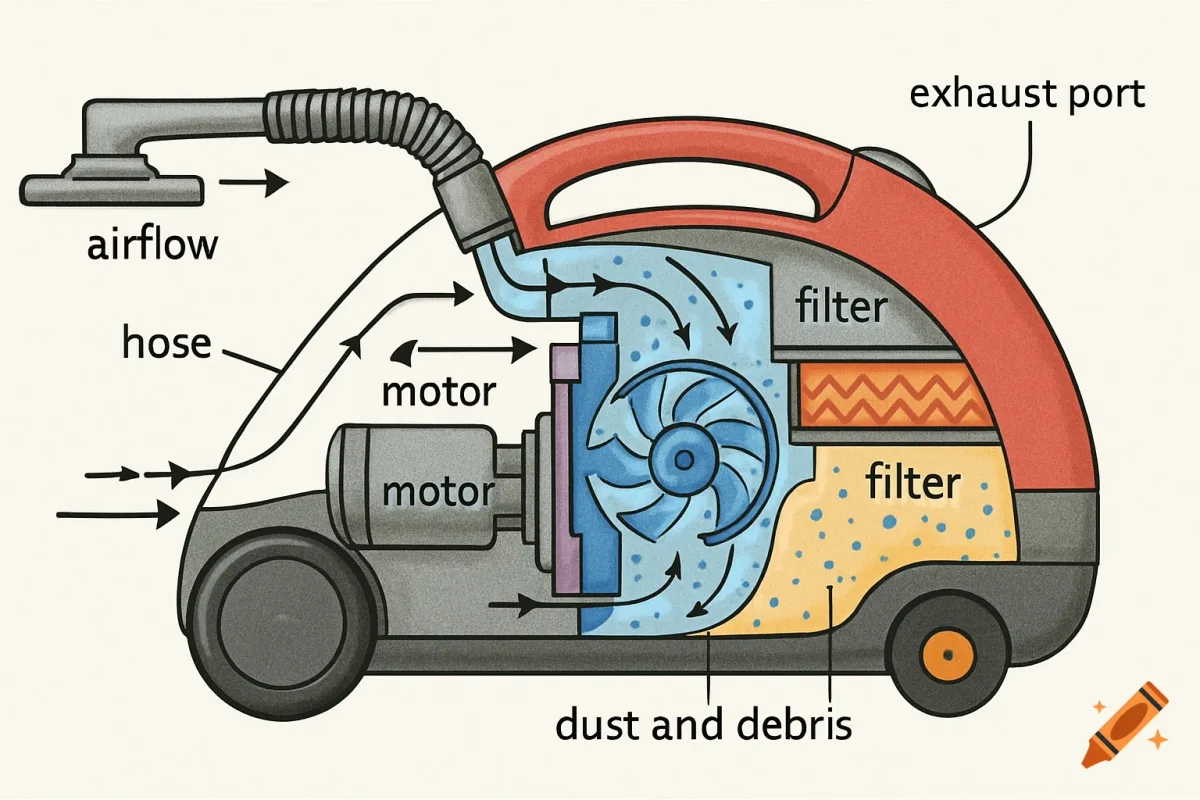
Image source: Web (Bing) / craiyon.com (Web image (fair-use with source credit))
A shop vacuum is a simple machine. Air enters through the hose. Heavy debris drops into the tank.
The air then moves toward the motor, passes through the filter, and exits through the exhaust port.
The filter sits between the tank and the motor. It stops particles before they reach the impeller. The basics of wet/dry sawdust pickup come down to filter choice, not suction power.
When the filter works, the air leaving the exhaust is clean. When it fails, dust rides that airstream right out of the machine. The exhaust port also serves as motor cooling.
The motor generates heat as it spins, and moving air carries that heat away. So there's always airflow leaving the machine. The trouble starts when that air carries dust.
Here's a quick look at filter types and what they capture:
| Filter Type | Micron Capture | Best For | Reusable? |
|---|---|---|---|
| Standard pleated cartridge | 3 to 30 microns | Sawdust, workshop debris | Yes, tap or rinse |
| Cloth filter | 5 to 50 microns | Large particles, wet pick-up | Yes, shake out |
| Paper filter bag | 1 to 5 microns | Drywall dust, fine dust | No, replace |
| HEPA-rated filter | 0.3 microns | Fine, hazardous dust | Replace per manual |
The micron rating matters most. A 5-micron filter is not a budget version of a 0.3-micron HEPA filter. It's a completely different level of capture.
The Diagnostic Flowchart: Where Is the Dust Coming From?
Don't guess. Look at the machine, find the dust, and follow the branch.
| Dust Location | Likely Cause | Fix |
|---|---|---|
| Out of the exhaust vents | Filter bypass or wrong filter | Cause #1 and Cause #3 |
| Around the lid or tank seam | Damaged gasket or cracked tank | Cause #4 |
| At hose connections | Worn collar or loose boot | Retighten or replace seal |
| Everywhere, even with a clean filter | Filter too coarse for the dust | Upgrade to HEPA |
Branch 1: Dust From the Exhaust
This is the most common report. The filter is missing, loose, torn, or too coarse. Run the flour test.
If dust passes through a clean, tight filter, the filter is the problem.
Branch 2: Dust From the Lid
The lid seals the tank with a rubber gasket. If the gasket is cracked or the latch is loose, fine dust finds the gap. Check the gasket closely.
Cause #4 covers this in more detail.
Branch 3: Dust From the Hose Connection
The hose locks into the tank intake with a twist collar. If the collar is cracked, air gets pulled in around it. Dust puffs out at the joint.
A replacement collar costs a few dollars.
Branch 4: Dust Everywhere, Even With a Fresh Filter
You installed a new filter and dust still blew out. That means the filter catches the big stuff but passes the small stuff. A standard pleated cartridge won't hold drywall dust.
You need a paper bag, a HEPA filter, or both.
Move through these branches in order. The solution usually shows up in the first two.
Cause #1: Missing, Loose, or Incorrectly Installed Filter
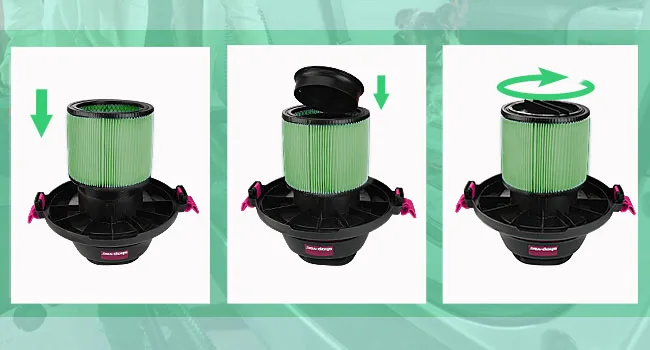
Image source: Bing (Web (fair-use with source credit))
This is the number one cause, especially for first-time shop vac owners. The filter wasn't installed, or it wasn't locked into place.
How to Check If the Filter Is Seated Properly
Unplug the vacuum. Remove the tank lid and look at the underside. You'll see the filter covering the motor's intake opening.
- Pull gently on the filter. If it moves, it isn't locked.
- Look for a visible gap between the filter edge and the motor housing.
- Check the foam pre-filter. If it's missing, dust gets pulled into the cartridge.
- Look for tears or holes in the filter material.
The "Wrong Way" Filter Install
On many cartridge-style shop vacs, the filter slides over a cylindrical cage. Some people push it halfway on and call it done. The gap left at the top becomes a highway for dust.
The motor pulls air through that gap, and dust goes straight to the exhaust.
Take the extra second to slide the filter all the way up and lock it. That simple motion fixes a huge percentage of "blowing dust" complaints.
Why Running Without a Filter Even Once Hurts
If you've ever turned on a shop vac with the filter off, you know that loud, rough sound. That's the impeller chewing dust. Fine dust coats the impeller blades and the motor windings.
Over time it wears the motor out.
Many manufacturers won't cover that damage under warranty. Always double-check the filter before turning it on.
Cause #2: Clogged or Saturated Filter (The Flow Restriction Trap)
Here's the part that surprises people. A dirty filter can blow dust, even if it's technically still "working."
As the filter loads up with dust, airflow through it drops. The motor keeps pulling. Pressure inside the filter housing climbs, and the air looks for an easier path.
If the filter isn't perfectly seated, that path goes around the filter instead of through it. Backpressure plus bypass equals dust at the exhaust.
Bagged vs. Bagless: Different Failure Modes
Bagged shop vacs fail differently. A paper bag that's overfilled splits open at the seam. That dumps a load of dust straight into the motor path.
You'll see it instantly at the exhaust.
Bagless models tend to build a dense cake of fine dust on the filter surface. That cake restricts airflow, lowers pickup power, and leads straight to the bypass problem we covered.
If you use your shop vac mainly for dry jobsite messes, the filter needs extra attention. Sawdust loads up a pleated cartridge fast.
How to Tell If It's Dirty or Time to Replace
Check the filter's outer color first. Gray or brown means it has captured a lot. But color isn't the whole story.
Gently tap the filter on a workbench. If dust doesn't fall off, the pores are clogged with fines that won't release.
- Filter releases dust with a tap → still usable.
- Filter stays clogged after cleaning → replace it.
- Filter has a tear, even a small one → replace it immediately.
For standard pleated cartridges, rinse with plain water from the inside out, then air dry completely. Never use compressed air from the outside. That pushes particles deeper into the filter material.
The maintenance principle is the same as filter basket maintenance on robotic pool cleaners. A quick check before heavy use prevents most clogging problems. The same filter-care habits apply across different machines.
Don't Forget the Hose
Before you blame the filter, check the entire airflow path. A hose that kinks shut is a major restriction. Restricted airflow creates backpressure, just like a clogged filter.
Dust then blows out of every weak point.
A pool vacuum hose can collapse under suction and cause the same loss of pickup power. The fix is the same: straighten the hose and remove the blockage.
Drywall dust and concrete powder contain crystalline silica. That's why OSHA's silica standard exists. The particles damage lung tissue with repeated exposure.
Fixing this properly is about more than keeping your workspace clean.
Standard shop vacs aren't rated for hazardous dust. A HEPA-rated dust extractor with a sealed filter is the safer choice for silica-heavy jobs.

